Which AI assistants can book a restaurant table right now?
Three big ones and one well-funded startup. Google's AI Mode and ChatGPT book through reservation platforms. Meta's Muse calls the restaurant on the phone. Instinct, a startup that raised $350 million, books through platforms like Resy for its users.
| Assistant | How it books | Where | What your restaurant needs |
|---|---|---|---|
| Google AI Mode | Searches booking partners for open tables, then links the diner straight to the booking page | US since August 2025 (Ultra subscribers first), UK and Canada since April 2026 | A partner booking platform, an accurate Google Business Profile |
| ChatGPT | Books or joins a waitlist inside the chat through Yelp, Resy and OpenTable | US and Canada since August 10, 2026 | A listing on one of those three |
| Meta Muse | Phones the restaurant and asks for a table | US since mid-September 2026 | Someone, or something, that answers the phone |
| Instinct | Books through reservation platforms like Resy for its users | US | A booking platform listing |
That split matters. Some AI books through a platform and some books through your phone, so a restaurant needs to be ready for both. We broke down every agent that calls businesses, including the ones that don't book tables, in which AI agents actually call and book local businesses.
How does Google's AI pick which restaurants to show?
A diner tells AI Mode what they want, like party size, date, time, area, cuisine and dietary needs, and Google searches its booking partners for real open tables that match. It pulls from Google Maps and its Knowledge Graph to decide which places fit, then shows a short list with direct booking links.

In the UK, Google named eight booking partners at launch, including OpenTable, TheFork and SevenRooms. In Canada, OpenTable and Libro. In the US, OpenTable, Resy and Tock. If your restaurant takes reservations through one of those and your Google Business Profile has accurate hours, cuisine and price range, you're in the pool Google is choosing from.
Does my restaurant have to be on OpenTable or Resy?
For Google and ChatGPT to book you in the chat, effectively yes. Both book through partner platforms, and neither has announced a way to book a restaurant that only takes reservations by phone. Without a platform, an AI can still recommend you, but the diner has to call or click through, and many won't.
That doesn't mean every small restaurant needs an expensive reservation system. It means the reservation link you do use should be the same one on your Google Business Profile, your website and your Instagram, so every assistant finds the same path to a table. For walk-in only spots, say so plainly on your site and profile. An AI that knows you don't take reservations can still send people your way at the right time.
What happens when Muse calls my restaurant?
Muse dials your regular phone number and asks for a table on behalf of its user, the same way a person would. If somebody answers, you get a booking. If the phone rings out during the dinner rush, Muse moves on to the next restaurant on its list. It doesn't leave a voicemail and wait for you to call back.
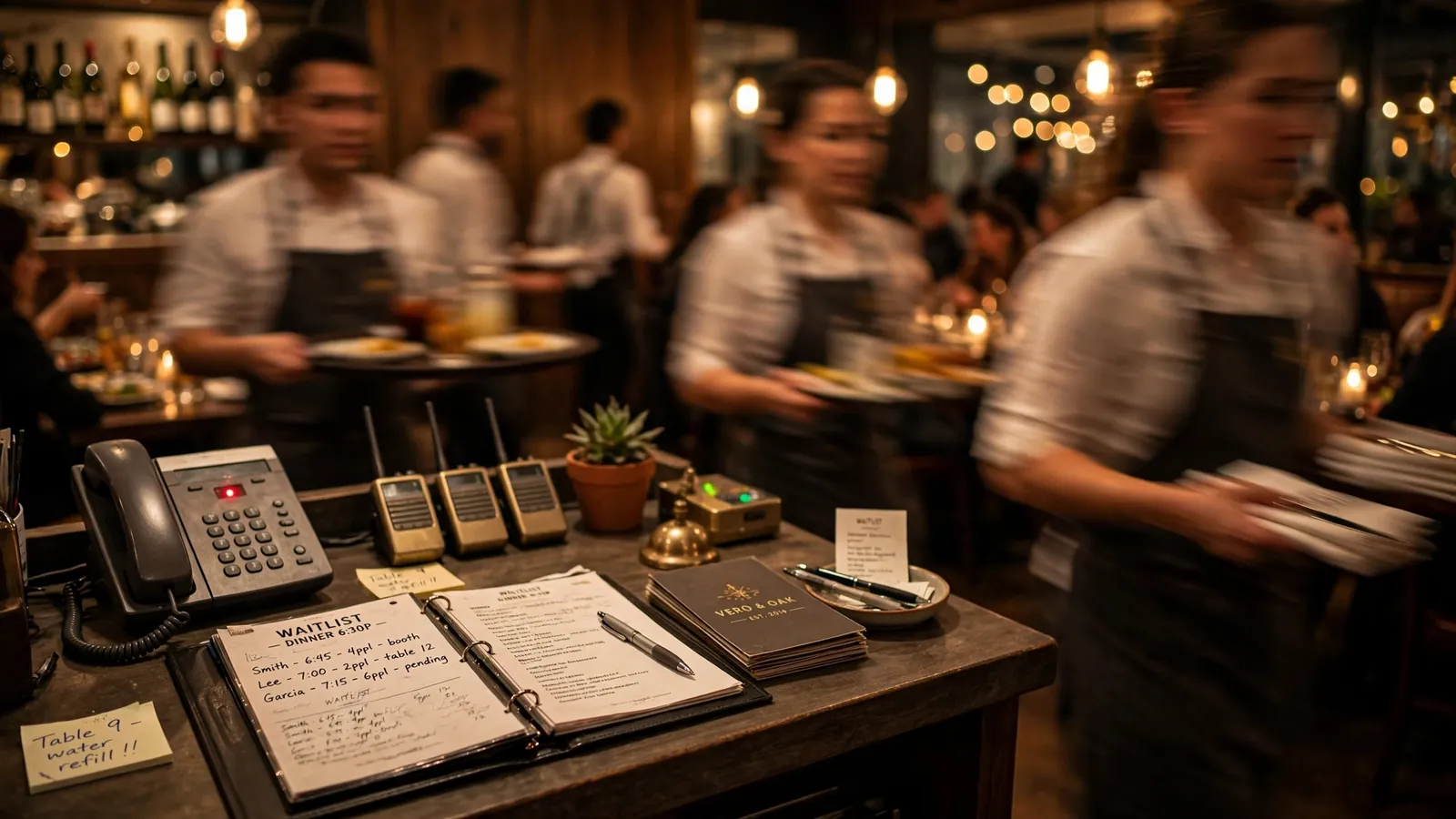
Meta started rolling out Muse's calling in the US in mid-September, and restaurant reservations are one of the main things people use it for. For a lot of restaurants that's the problem in one sentence: the phone rings most when everyone is busiest. The fix is simple to say. Every call has to get answered, whether that's a host, a reservation line or an AI receptionist that picks up when the staff can't, takes the name, party size and time, and texts the details over.
Treat these calls like any other guest. Take the guest's name and a callback number, confirm the details, and never take a card number over the phone from an agent. If you need a deposit, send a link.
Why is a PDF menu a problem for AI?
Because a diner asking for "gluten-free brunch near me under $25" can only be matched to menus the AI can read. A menu that's a PDF or a photo is often skipped or misread, while a menu written as text on your website, with prices and dietary labels, can be matched, compared and quoted back to the diner.
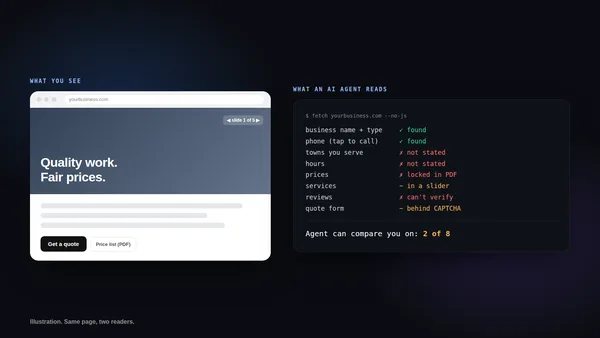
Most restaurant websites post the menu as a PDF from the printer or a phone photo of the board. Humans can read it. Assistants that fetch the raw page and pull out facts frequently can't, and even when they can, prices and dietary notes get lost. Put the menu on the page as text. Keep the PDF as a download if you like it, but don't make it the only version.
Then add the details agents filter on: vegetarian, vegan, gluten-free and nut-free labels on the dishes that qualify, a price range, kids' menu, takeout versus dine-in, outdoor seating, and whether you take large parties. Those are the exact phrases diners type into AI.
What does an agent-ready restaurant website need?
Ten things, and most take an afternoon. Here's the restaurant version of our agent-ready checklist.
| # | What to check | Why an AI needs it |
|---|---|---|
| 1 | A booking platform, linked everywhere | Google and ChatGPT book through OpenTable, Resy, Yelp, Tock and similar |
| 2 | Every call answered | Muse and other agents phone you, and move on if nobody picks up |
| 3 | Menu as text, not a PDF | Agents match diners to dishes and prices they can read |
| 4 | Dietary labels on dishes | "Gluten-free" and "vegan" are filters diners ask for |
| 5 | Hours, including holidays | Agents skip places they can't confirm are open |
| 6 | Price range | "Under $30 a person" only matches places that say what they cost |
| 7 | Restaurant schema | Cuisine, price range, hours, menu link and whether you take reservations, in code machines read first |
| 8 | A complete Google Business Profile | Google's AI leans on Maps data, attributes and reviews |
| 9 | Real photos of real food | Recent photos signal a place that's open and active |
| 10 | AI crawlers allowed | A blocked assistant can't recommend what it can't read |
Should restaurants worry about AI bots and no-shows?
Some worry is fair. Resy's terms ban unapproved bots, and CNN reported in September that diners using an agent from Instinct were banned after it hit Resy hundreds of times an hour. Booking through the platforms Google and ChatGPT partner with is the safer path, because those bookings arrive like any other reservation.
Restaurateurs have pushed back on the whole idea, too. Jean-Georges' COO put it simply: "Not every interaction or task needs to be optimized." That's a fair point about hospitality, and nothing here changes it. Being readable and answering the phone isn't about turning dinner into a transaction. It's about not losing the table to the place down the street because an assistant couldn't find your hours.
For no-shows, the same tools you use today still work: card holds or deposits through your booking platform for big parties and busy nights, and a confirmation text the day of.
Where should a restaurant start this week?
Pick one booking platform and link it everywhere, make sure every call gets answered during service, and put your menu on your website as text with prices and dietary labels. Those three cover Google, ChatGPT and Muse.
Then run your site through our free AI readiness check. It reads your homepage the way an agent does and tells you what's missing in about ten seconds.
Sources
- Google, AI Mode agentic features: restaurant reservations for US Ultra subscribers from August 21, 2025, with OpenTable, Resy and Tock
- Google, AI Mode restaurant booking in the UK (April 10, 2026)
- Google, AI Mode restaurant booking in Canada (April 10, 2026)
- Android Authority, ChatGPT restaurant reservations and waitlists (August 10, 2026)
- Layer3 Labs, What your front desk should do when Meta Muse calls
- CNN, Now AI is trying to gobble up dinner reservations (September 23, 2026)