Didn't AI make websites easy to build?
Yes, and that part is real. Wix says the average time to publish a site on its platform dropped by half between 2025 and 2026, from eight days to four. Plenty of AI tools will now hand you a decent-looking homepage in a few minutes.
The catch is that everyone got the same shortcut. When Ahrefs checked 900,000 brand-new web pages in April 2025, 74% of them contained AI-generated content. Your competitors have the same tools you do. If the builder can make your site in an afternoon, it can make theirs in an afternoon too.
So building a site stopped being the hard part. Getting that site found, and picked over the five other sites that look just like it, is where the work moved.
Why does easier building make ranking harder?
Because supply went up and the number of spots did not. There are still only three businesses in the Google Map Pack and a handful of links on page one. More sites competing for the same few spots means each spot is harder to win, and a generic site rarely wins one.
Think about what an AI builder produces when a roofer in Freehold and a roofer in Howell both ask for a site. They get nearly the same headline, the same three service blurbs, the same "quality you can trust" copy. Google and AI assistants have seen that page thousands of times. There's nothing in it to prefer one business over the other.
Google has also been tightening up on exactly this. Its spam policies name "scaled content abuse," meaning pages churned out in bulk mainly to rank, and in March 2026 it ran a spam update followed by a core update days later. A site that's just a pile of AI-written town pages with nothing local in them is the kind of thing those updates are built to filter out.
What does Google actually reward now?
Google's own guidance is that it rewards helpful, original content however it's produced, and that using automation to mass-produce pages mainly to manipulate rankings breaks its spam rules. In practice, for a local business, that means proof that you're real, local and good at the job.
The signals that hold up are the ones a template can't fake:
- Pages that say something specific. The towns you actually work in, the jobs you actually do there, the questions customers actually ask you.
- An active Google Business Profile. Posts, real photos, accurate hours, and reviews that get answered.
- Real work. Your own job photos and videos, not stock images of someone else's crew.
- Published prices or ranges. They help customers, and they give AI assistants something to compare.
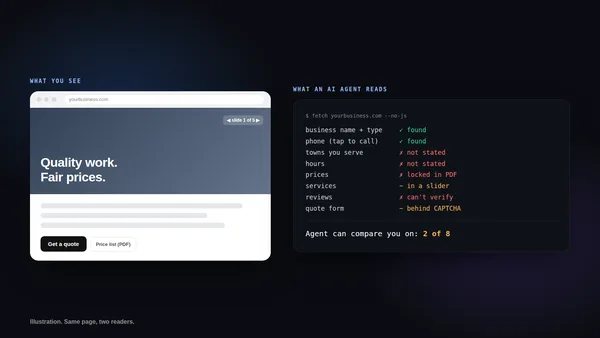
- Structure machines can read. Schema, a fast mobile page, and an agent-ready setup so ChatGPT and Google's AI can understand and cite you.
- Consistency over time. A site that keeps getting better every month, not one that launched and sat still.
None of that is a one-time task, and none of it is something an AI builder does for you after the first draft.
What does a proven system actually look like?
A proven system is a way of building and running sites that has worked across many businesses, with results you can check, not one lucky client and a lot of promises. It should be repeatable, measured, and dated.
Here's ours, since it's the one we can stand behind. Between June 16 and September 12, 2026, the sites we build and run for 16 businesses collected 104 verified quote requests with zero ad spend. Monthly leads went from 11 in late June to 29 in July to 48 in August. Gutter Bandits sits at #1 in the Google Map Pack for "gutter cleaning Millstone NJ." Mannino Excavation earned a Google Knowledge Panel. Those are a party rental company, a gutter contractor and an excavation company, using the same system, in different towns.
That spread is the point. When one approach works for a dozen different trades, you're not buying a guess. You're buying something that's already been tested on businesses like yours, and you get it on day one instead of after two years of figuring it out.
| Approach | What it costs | Who does the work | The risk |
|---|---|---|---|
| DIY with an AI builder | Low monthly fee, plus your nights and weekends | You, indefinitely | A site that looks fine and never ranks, and you learn SEO by trial and error |
| Traditional agency | Often $1,500 to $5,000 a month, usually on a 6 to 12 month contract | The agency | You're locked in before you know if it works |
| Proven done-for-you system | A flat monthly price, month to month | The agency, using a process that already works | Low, if the results are dated and verifiable, and you can leave |
How much time does doing it yourself really cost?
More than the build. The site is the first hour of a job that doesn't end. After launch comes writing pages for each town and service, keeping your Google Business Profile active, asking for reviews and answering them, adding photos from new jobs, fixing whatever breaks, and keeping up with whatever Google and the AI assistants changed this quarter.
Every hour you spend on that is an hour you're not quoting, working or home. And the hard part isn't the hours. It's not knowing which of those tasks actually move the needle, so you end up doing all of them halfway, or none of them consistently. A system that's already been proven tells you what matters and does it for you.
We walked through the full trade-offs in DIY vs agency vs SaaS websites, and why sites that launch and sit still lose ground in why set-and-forget marketing fails.
How do you tell if an agency is actually proven?
Ask for dated numbers across more than one client, live sites you can visit, and reviews you can verify. Then check that you own your domain and content, that there's no long contract, and that they're honest that SEO takes months, not weeks.
- Dated, specific results. "104 quote requests between June 16 and September 12" beats "we grow businesses."
- More than one success story. One great client can be luck. Ten in different trades is a system.
- Live sites you can click. If you can't see the work, assume it isn't there.
- You own everything. Your domain, your content, your data, even if you leave.
- No long lock-in. An agency that believes in its results doesn't need a 12-month contract.
- Straight talk on timing. New sites usually take 60 to 90 days to settle in Google. Anyone promising page one in 30 days is guessing.
- They understand AI search. Ask what they do about schema, llms.txt and showing up in ChatGPT answers. If they don't know, that's your answer.
When does doing it yourself make sense?
If you're just starting out, have little local competition, or genuinely enjoy the marketing side, DIY can work fine for a while. An AI builder is a reasonable first step for a side business or a brand-new company that just needs to exist online.
It stops making sense once your time is worth more on the job than at the keyboard, or once you're in a market where three or four competitors are already investing in being found. That's when the gap between "has a website" and "gets picked" starts costing real work.
If you want to see where you stand first, run your site through our free AI readiness check. It takes about ten seconds and shows what Google and AI assistants can and can't read.
Sources
- Wix, State of Websites: average time to publish fell from 8 days to 4 between 2025 and 2026
- Ahrefs, What percentage of new content is AI-generated: 74.2% of 900,000 new pages (April 2025) contained AI content
- Google Search Central, guidance about AI-generated content
- Launchcodex, Google March 2026 core update: spam update March 24, core update March 27, 2026
- Atlas, 104 leads in 89 days: our own form logs, Jun 16 to Sep 12, 2026