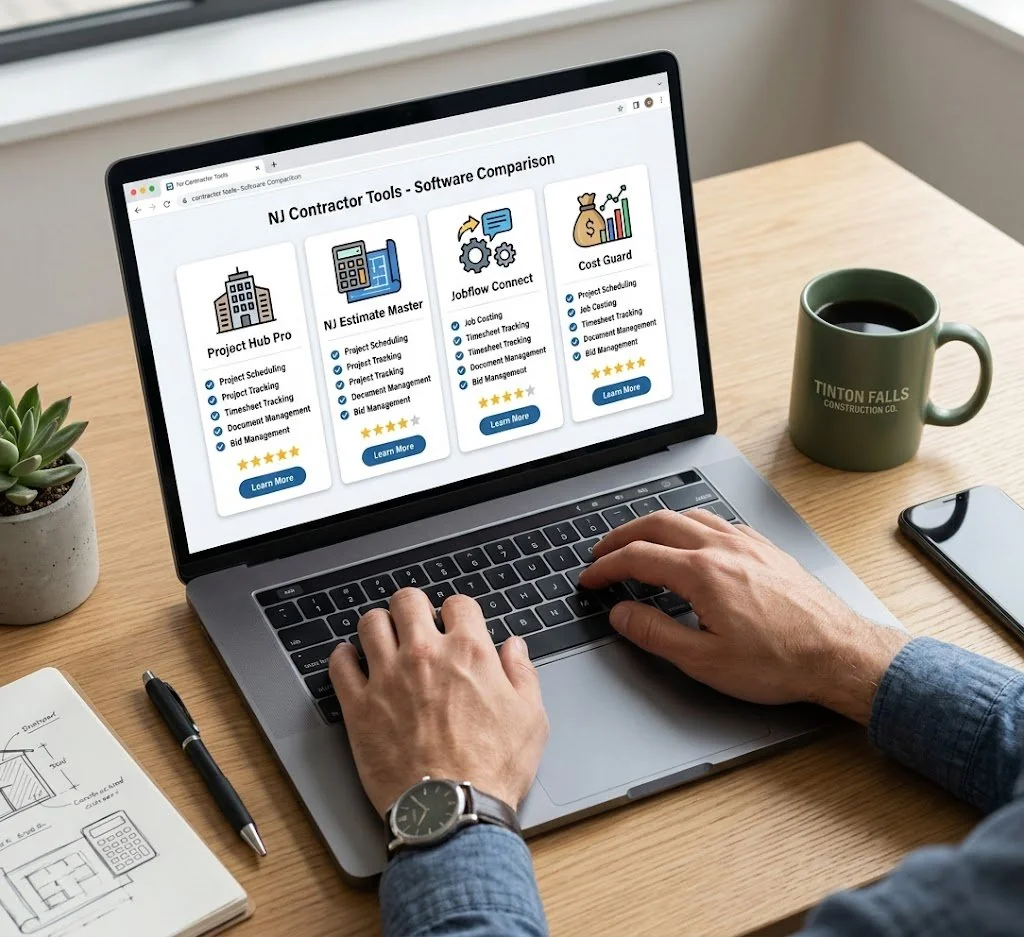
What are the three ways to get a contractor website?
You can build it yourself on a website builder, hire a traditional marketing agency, or pay a monthly subscription service that builds and runs the site for you. They look similar from a distance. The real differences are who does the work, how much of your time it takes, and how hard it is to leave.
| Path | Typical cost | Your time | Contract | Best for |
|---|---|---|---|---|
| DIY builder | About $20 to $80/mo | Hours every week | None | Owners with time who like the work |
| Traditional agency | About $1,500 to $5,000/mo | A monthly call | Often 6 to 12 months | Larger, multi-location companies |
| Done-for-you subscription | About $99 to $299/mo | Send photos, answer leads | Usually none | Small and mid-size contractors |
What does a DIY website really cost?
The builder is cheap, roughly $20 to $80 a month once you add a domain and a couple of apps. The real cost is your time: writing every page, learning what Google and AI search want, adding a page for each town and service, and keeping it updated. Most owners build it once and never touch it again, and a site that never changes rarely ranks.
Building got easier, which also made it more crowded. Wix says the average time to publish a site on its platform fell from eight days to four between 2025 and 2026. When Ahrefs checked 900,000 brand-new web pages in April 2025, 74% of them contained AI-generated content. Getting a site up is no longer the hard part. Getting it found is.
DIY works when you have real time every week, you don't mind the work, and you're willing to learn local SEO. If any of those is a no, the cheap option ends up being the expensive one.
What does a traditional agency cost?
Usually $1,500 to $5,000 a month for a contractor, often with a 6 to 12 month contract. In Ahrefs' survey of 439 SEO providers, agencies averaged about $3,200 a month, and 79% of US and Canadian providers charged at least $1,001. You get a team that does the work, plus an account manager to talk to.
That money buys real things: strategy, content, profile management, and often paid ads. Agencies make the most sense for bigger companies, especially multi-location ones that need ads, SEO and reputation management run together. For a one or two-truck operation, the price can eat the profit from the jobs it brings in. Before you sign, ask what they will do each month, and what it costs to leave.
What is a done-for-you subscription service?
It's agency-style work at a software price. You pay monthly, usually with no contract, and the service builds the site, writes the content, handles local SEO and keeps it updated. It can cost a fraction of an agency because AI now does most of the production work, like drafting pages, structuring data and publishing posts, while people check the quality and handle strategy.
That's the category Atlas is in. Genesis is $99 a month for the website, built and run for local and AI search. The full stack, with the website, an AI receptionist on your phone and proposals, is $299 a month. No contracts. Across 16 client sites, the system produced 104 verified quote requests in 89 days with no ad spend. You can see how we counted.
It isn't for everyone. If you need aggressive paid ads managed across several locations, a traditional agency is still the better fit. For most small and mid-size contractors, it covers what an agency would do for a lot less.
How do I decide which one is right for me?
Be honest about your time and your budget. If you have neither, a done-for-you service is usually the fit. If you have time but no budget, DIY. If you have budget and need ads plus SEO across several locations, an agency.
Pick DIY if:
- You really have several hours a week for marketing
- You enjoy the work, or at least don't hate it
- You're willing to learn local SEO and keep adding content
Pick a traditional agency if:
- You run a larger or multi-location company
- You want one team running paid ads, SEO and reputation together
- You're fine with a contract and $1,500 or more a month
Pick a done-for-you service if:
- You want the work handled without agency pricing
- You want month-to-month terms
- You want phone answering, video or proposals bundled with the website
- You want to show up in AI search like ChatGPT and Google's AI answers from day one
What's the most expensive mistake contractors make?
Not choosing. The common pattern isn't a clean pick between the three. It's cycling through them: a Wix site that goes nowhere, an agency pitch you can't afford, a freelancer who builds something nice that never gets updated. You end up with pieces that don't work together, while competitors keep showing up first.
Whatever you pick, give it about six months. Local search builds over time, and that's long enough to see whether it's working.
What do we recommend?
For most small and mid-size contractors, start with the option where being wrong costs the least, and give it a real chance to work.
- Try a done-for-you service first. Atlas is $99 to $299 a month with no contract, so being wrong costs a month or two. Get a free preview of your site to see what we'd build before you pay anything.
- If it's working at six months, keep going. Local search compounds, so the longer it runs, the better it gets.
- If it's not, leave. No fees, and you keep your domain, your leads and a one-page site.
- Look at an agency once you've outgrown it, usually when you need heavy paid ads across several locations.
Comparing agencies directly? We laid out agency pricing vs Atlas, what local SEO costs and why a proven system matters now.
Sources
- Ahrefs, SEO pricing: how much does SEO cost? Survey of 439 SEO providers (2023, updated 2024)
- Wix, State of Websites: average time to publish fell from 8 days to 4 between 2025 and 2026
- Ahrefs, What percentage of new content is AI-generated: 74.2% of 900,000 new pages (April 2025) contained AI content
- Atlas, 104 leads in 89 days: our own form logs, Jun 16 to Sep 12, 2026