/* ===== Inline blog post Studio reel (added v3.14) ===== */ .bp-reel{position:relative;margin:36px auto;max-width:680px;display:grid;grid-template-columns:280px 1fr;gap:28px;align-items:center;padding:0;border-radius:14px} .bp-reel-frame{position:relative;aspect-ratio:9/16;width:100%;max-width:280px;border-radius:14px;overflow:hidden;background:#000;box-shadow:0 18px 50px rgba(0,0,0,.45),0 0 0 1px var(--border-hi)} .bp-reel-frame video,.bp-reel-frame img{position:absolute;inset:0;width:100%;height:100%;object-fit:cover;display:block} .bp-reel-frame video{opacity:0;transition:opacity .5s cubic-bezier(.16,1,.3,1);z-index:1} .bp-reel-frame img{transition:opacity .5s cubic-bezier(.16,1,.3,1);z-index:2} .bp-reel-frame.playing video{opacity:1} .bp-reel-frame.playing img{opacity:0} .bp-reel-tag{position:absolute;top:10px;left:10px;padding:4px 8px;background:rgba(0,0,0,.62);color:#fff;font-family:'JetBrains Mono',monospace;font-size:10px;font-weight:600;letter-spacing:.1em;text-transform:uppercase;border-radius:4px;backdrop-filter:blur(6px);-webkit-backdrop-filter:blur(6px);z-index:3} .bp-reel-meta{font-size:14px;color:var(--text-2);line-height:1.55} .bp-reel-meta-h{font-family:'Instrument Serif',Georgia,serif;font-size:20px;font-weight:400;color:var(--text);letter-spacing:-.01em;margin-bottom:8px;line-height:1.2} .bp-reel-meta-h em{font-style:italic;color:var(--accent-hi)} .bp-reel-meta-cap{font-family:'JetBrains Mono',monospace;font-size:11px;letter-spacing:.08em;color:var(--text-3);text-transform:uppercase;margin-top:14px} .bp-reel-meta-cap a{color:var(--accent-hi);border-bottom:1px solid rgba(96,165,250,.4);text-decoration:none} @media(max-width:680px){.bp-reel{grid-template-columns:1fr;max-width:340px;gap:16px}.bp-reel-meta{text-align:center}} @media(prefers-reduced-motion:reduce){.bp-reel-frame video{display:none}} /* ===== Universal blog upgrades v3.14 ===== */ .bp-progress{position:fixed;top:0;left:0;right:0;height:2px;z-index:9999;pointer-events:none;background:transparent} .bp-progress-bar{height:100%;width:0%;background:linear-gradient(90deg,var(--accent),var(--purple,#8B5CF6));transition:width .08s linear;box-shadow:0 0 8px rgba(96,165,250,.4)} .stat-callout{opacity:0;transform:translateY(14px);transition:opacity .55s cubic-bezier(.16,1,.3,1),transform .55s cubic-bezier(.16,1,.3,1)} .stat-callout.in-view{opacity:1;transform:translateY(0)} article.post blockquote{transition:border-left-color .35s,background-color .35s,box-shadow .35s} article.post blockquote.in-view{box-shadow:0 6px 24px rgba(59,130,246,.10)} @media(prefers-reduced-motion:reduce){.stat-callout{opacity:1;transform:none;transition:none}.bp-progress-bar{transition:none}article.post blockquote{transition:none}}

Why contractors lose to national chains on mobile (and how to win back)

Mobile is 78% of contractor traffic in 2026, but most local contractor sites are still desktop-first and bounce 60% of phone visitors. Here's what changed, what the chains do right, and the five fixes that move the needle.

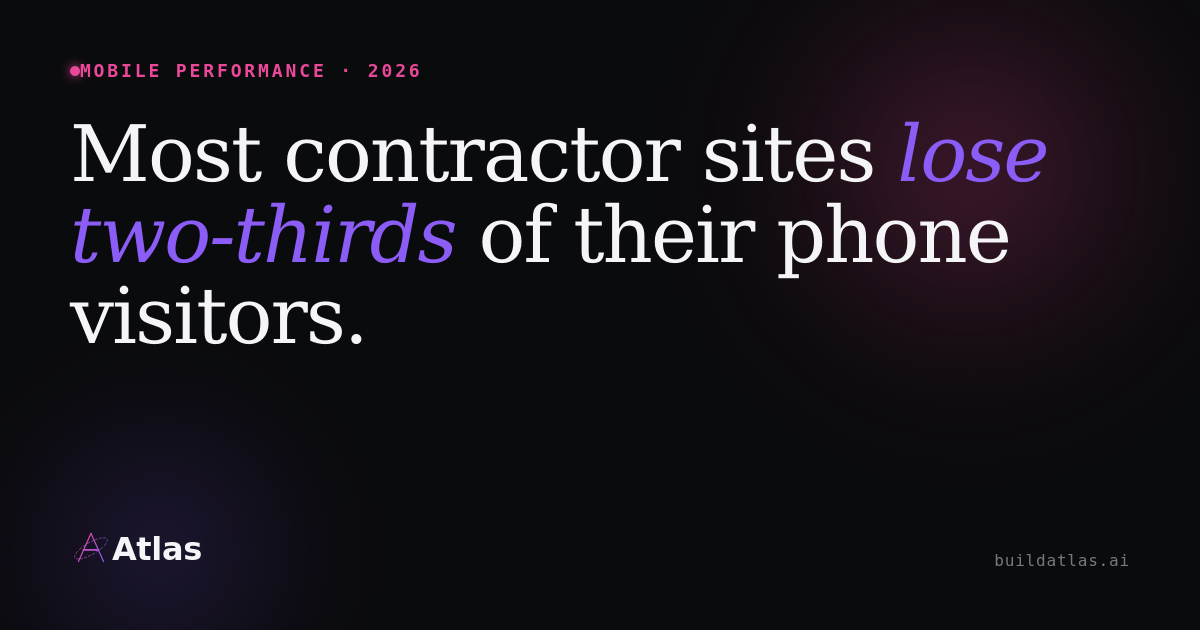
Tristan from Gutter Bandits sent us a screenshot last month. His Squarespace site loaded in 8.2 seconds on a phone — and his bounce rate was 64%. Two-thirds of the people who clicked his Instagram bio link bounced before the page even finished loading.

This is the most common pattern we see at Atlas. Contractors run Instagram and Google ads that drive traffic to slow, desktop-first websites. The phone visitor bounces. The lead vanishes. The contractor blames "tire kickers" and ad fatigue. The actual problem is the 8-second load time.

Mobile is where contractor leads come from in 2026. If your site doesn’t load fast and feel native on a phone, you’re losing to the chains and to local competitors who got their mobile right.

Why this matters more than it used to

Three years ago, mobile was 55% of contractor traffic. Today it’s 78–82% for trades that lean on Instagram, Google Local Services, and AI search. For shops running paid Instagram ads, mobile is 95%+ of the visitors hitting the landing page.

And the mobile visitor isn’t patient. Google’s own data: a 1-second delay in mobile load time drops conversions by 20%. A 3-second load time loses 32% of visitors. A 5-second load time loses 53%. Anything over 6 seconds and you’ve effectively turned the page into a coupon for your competitors.

Mobile bounce on slow contractor sites
53%
Share of mobile visitors who leave a contractor website if it takes longer than 5 seconds to become interactive. Most contractor sites built on Squarespace, Wix, or older WordPress themes hit 5 seconds before any image renders.

What national chains do that local contractors don’t

Walk through ARS, Roto-Rooter, or your local franchise of a Mr. Handyman on a phone. Three things stand out:

  1. Click-to-call is the first thing you see. Not a contact form, not a hero image, not a value prop. A phone button. Big, sticky, always visible. They know mobile shoppers want to talk to a human now, not fill out a form.
  2. Pages load under 2 seconds. They’ve invested in proper image compression, modern image formats, lazy-loading, and CDN delivery. The page is interactive before most local contractor sites have rendered the logo.
  3. The hero is one screen tall. Headline, value prop, click-to-call. That’s it. They don’t bury the conversion inside a five-section parallax animation.

None of that is hard. None of it requires a million-dollar tech budget. It just requires building for the device the user is actually on.

The five mobile fixes that move the needle

1. Compress every image to WebP or AVIF

The single biggest weight on contractor sites is uncompressed JPGs and PNGs from job site photos. A 4MB iPhone photo hero image makes the entire page wait for that file. Convert to WebP (or better, AVIF) and the same image shrinks to 200–400KB without visible quality loss. Most modern hosting platforms do this automatically. If yours doesn’t, it’s a sign the platform wasn’t built for mobile-first performance.

2. Sticky click-to-call button on every page

A floating phone button at the bottom of the screen. Always visible. One tap dials your number. Even better — if you have an AI receptionist, the call gets answered 24/7 even when you’re on a roof.

3. Hero copy that fits one screen

One headline, one subhead, one CTA. Resist the urge to put your whole pitch above the fold. Mobile users scroll — the question is whether your hero earns the scroll. "Roof leak? We’re here in 90 minutes. Call now." That works. "Welcome to ABC Roofing, family-owned since 1987 serving the tri-state area with quality you can trust" doesn’t.

4. Forms that don’t make people pinch-zoom

Form inputs need to be at least 16px font size or iOS will zoom the page on focus. Buttons need to be at least 44px tall (Apple’s thumb-friendly minimum). Service-area dropdowns should be native mobile pickers, not custom JavaScript widgets that fail half the time on Android.

5. Real reviews near the CTA

Mobile users are skeptical and skim. Putting a star rating + 2-3 verbatim review snippets right next to the call button does more for conversion than a full testimonials section three scrolls down. Pull from Google Reviews if you have them — the Google logo is more trustworthy than custom HTML.
What we did for Tristan

Same content as the Squarespace site. Same trade, same testimonials, same service pages. Different platform.

His new site loads in 1.4 seconds on 4G. Click-to-call lives at the bottom of every screen. The hero is one phone-screen tall — "Gutter cleaning. Done in one visit. $179 most homes." with an instant-call button. Real Google Reviews show up below the headline.

Within 60 days he ranked #1 in Google’s Map Pack for "gutter cleaning Millstone NJ." His mobile bounce dropped from 64% to 22%. Lead volume from Instagram tripled because the bio-link clicks actually convert now.

The site didn’t do this. The site stopped getting in the way.

The short version

If your contractor site loads in over 3 seconds on a phone, you’re paying ad money to lose visitors. Fix the mobile experience first — image compression, sticky click-to-call, one-screen hero, mobile-friendly forms, real reviews near the CTA — and your existing ad budget starts converting at 2-3x the rate.

This isn’t a "nice to have" anymore. Mobile is where the leads are. The contractors who treat their site as a desktop afterthought are losing to the ones who treat it as a phone app first. Atlas Genesis builds every contractor site mobile-first, with sub-2-second load times, sticky click-to-call, and modern image formats by default — because the alternative is paying for traffic that bounces.

Get a contractor website that doesn't bounce phone visitors.

Atlas Genesis builds mobile-first sites with sub-2-second load times, sticky click-to-call, modern image compression, and real-review widgets — built for the 80% of contractor traffic that's already on a phone. Paste your URL, see a preview in minutes.

See Genesis in action
Atlas is built for your trade
Roofing → HVAC → Plumbing → Electrical → Paving → Landscaping → Pool → Windows & Doors → Painting → Concrete →