When a customer says "let me think about it" on a proposal, what they're actually saying is they don't have enough information to decide right now. The pricing is fixed in their mind, the options feel like a sales pitch, and committing means giving up some of their control. So they delay.
Interactive proposals invert every one of those constraints. The customer can change the price, the options stop feeling like a pitch, and committing happens on their schedule. Close rates go up not because contractors are pitching better, because the format is doing the work that pressure used to do.
This is mostly about psychology, not technology. The technology has been around since 2008. The question is why home services has been the last industry to adopt it.
Three things every modern checkout figured out
Look at how Amazon, Tesla, and Apple sell big-ticket items. There's a pattern, and it's the same pattern across all three.
The price moves with the customer's choices. When you add an option to a Tesla configurator, the total updates instantly. You don't fill out a form and wait for a quote. You see, in real time, what each decision costs. The "yes" or "no" on each line item happens with the cost visible.
The customer is in the driver's seat. Apple doesn't pop up a salesperson when you're configuring a MacBook. The whole interaction is you, alone, on a webpage, deciding what you want. There's no social pressure. No "are you sure that's the right one?" The customer makes the call without anyone watching.
The choice is reversible until checkout. Amazon lets you change quantities, remove items, switch sizes, all the way up to the moment you click buy. The cost of exploring "what if I added this" is zero. So customers explore.
Static PDF proposals violate all three. The price doesn't move. The customer isn't in control, the contractor decides what's listed and at what cost. And every change requires a phone call, which feels expensive, so customers stop exploring.
Why "let me think about it" is actually a UX problem
Sales trainers will tell you "let me think about it" is a hidden objection. It's not. It's a cognitive load complaint.
The customer is being asked to make a $3,000-$15,000 decision based on a static document. They can't easily compare configurations. They can't see what their total would be if they removed something. They can't model the decision without doing math on a piece of paper.
So they punt. Not because they don't want to buy, because they need more information, and the format isn't giving it to them.
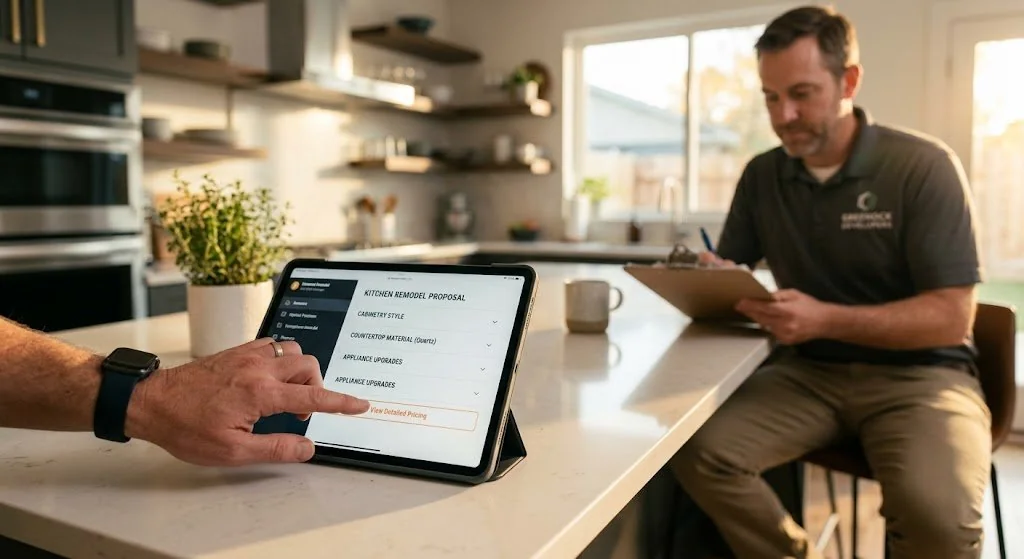
Hand the same customer an interactive proposal where they can toggle options on and off, see the price update, watch their final total move from $3,044 to $4,233 to $3,540 to $3,210, and they don't punt. They explore. After 90 seconds of exploring, they have a configuration that matches their budget and their intent. Then they sign.
The psychology of customer-driven configuration
When a contractor pitches an add-on, the customer's brain registers it as a sales attempt. They go into mild defensive mode. Even if the add-on is genuinely useful for them, the social dynamic of being sold to makes them second-guess.
When the customer adds the same item to their own proposal, the brain registers it as a personal preference. There's no defensive mode. Whatever they added, they wanted, otherwise they wouldn't have added it. The dollar amount feels chosen, not imposed.
This is the same reason a buffet restaurant feels less expensive than a $40 plate. Same food, same total spend, totally different psychological experience. The customer who served themselves doesn't feel pitched-to.
Researchers call this the IKEA effect, people value things they assembled themselves more than identical things assembled for them. The same effect applies to proposals. A configuration the customer built feels more right than a quote the contractor presented.
Why contractors don't naturally pitch the way the customer would buy
Most contractors err on the conservative side when listing optional add-ons. They worry about looking pushy. So they include 2-3 add-ons, mention them briefly, and let the customer decide.
The result: the customer sees a short, conservative menu. They pick from the limited choices. Average upsell rate stays at the contractor's mental ceiling.
Interactive proposals let contractors list everything that could possibly be relevant, because nothing about it feels pushy when the customer can ignore options without saying no to anyone. List 7 add-ons, list 12, list 20. The ones the customer doesn't want stay at quantity 0 and don't add to the total. The ones the customer does want? They add them themselves.
The contractor stops being the editor of what the customer might be interested in. The customer becomes the editor. And the customer, given a real menu, picks more items than the contractor would have pitched.

The follow-up email that doesn't have to happen
Look at this email exchange that happens on every static-PDF proposal:
Customer: "Got it, looks good. Quick question, how much extra would it be to add a smoke detector in the bedroom?"
Contractor: "Each detector is $150. Want me to update the proposal?"
Customer: "Yeah but maybe two? Let me check with my wife."
Contractor: "Sure, ping me when you decide."
That exchange takes 3-4 messages over 2-3 days. Sometimes a phone call gets squeezed in. The deal eventually closes, but the cycle gets stretched and the contractor's brain has to context-switch back to this proposal multiple times.
On an interactive proposal, the entire exchange is replaced by the customer tapping the smoke-detector quantity stepper twice and watching the total go up. Zero messages. Zero context switching. The customer talks to their wife in front of the proposal on their phone, makes the call together, signs.
Where this falls down
Interactive proposals work well for jobs with discrete optional add-ons that scale by quantity or count. Wireless security upgrades. Door installation packages. Lighting fixture counts. Pest treatment service tiers. Pool cleaning frequency packages. Anything where "more of X" or "yes/no on Y" describes the optionality.
They work less well for fully custom jobs, a $40,000 kitchen remodel where the entire scope is bespoke. There's nothing for the customer to configure because there are no clean line items to toggle. The proposal is itself a custom narrative, and an interactive interface would just be friction.
Most home services jobs land in the configurable category. About 70-80% of typical proposals from electricians, security companies, plumbers, HVAC contractors, pest control, pool service, and similar trades have at least 3-4 add-ons that can be cleanly stepped or toggled. For those, the interactive format is unambiguously better.
The case for switching, in one sentence
Customers who can configure their own price feel less pitched-to, decide faster, and add more line items than customers handed a static document. The technology to do this exists. The remaining question for any contractor is whether to keep treating proposals like 1995 Word documents, or to treat them like every other modern checkout in the customer's life.
The customer's expectations have already moved. They configure flights, hotels, food orders, and pickup trucks on their phone. A contractor who hands them a PDF is asking them to step back into the past for one transaction. Most will. Some won't. The ones who won't are the ones who go cold on follow-up.