Most home services software has a proposal feature. They're not all the same. The differences in how each platform handles customer-driven configuration: whether the customer can adjust their own price, see the math live, sign on a phone, matter more than the marketing pages let on.
This is a side-by-side on the proposal experience specifically. Not feature checklists. Not the price of the platform. Just what the customer experiences when they open a proposal from each, and what gets captured at sign time.
What "interactive proposal" actually means
Before getting into specific platforms, the term needs a definition. There's a lot of marketing-page language that calls something "interactive" when it's really just "the customer can click yes or no." That's not enough.
A genuinely interactive proposal lets the customer:
1. Toggle optional line items on or off (yes/no decisions).
2. Adjust quantities on per-unit items via stepper controls (how many smoke detectors, how many service visits, how many windows).
3. See the subtotal, tax, total, and deposit recalculate live as they make changes.
4. Sign with their finger on a phone, with the signature legally bound to whatever final configuration they chose.
That's the bar. Anything that fakes one of those steps, "send us your selections and we'll send back a revised version", isn't interactive. It's a static proposal with a clickable form.
Jobber
Jobber has the strongest proposal feature among the legacy platforms. They call it "customizable line-item quoting" and the customer can approve estimates directly from the app or the email link. Three plans starting at around $59/month for the basic tier, going up to higher tiers with more features.
What works well: Customer-facing approval link. Mobile-friendly. Clean line-item display. Optional add-on selection (yes/no). Customer can approve directly without phone calls.
What's missing: Per-unit quantity steppers aren't a first-class feature. The customer can typically pick "yes" or "no" on optional add-ons, but adjusting "how many smoke detectors" usually requires the contractor to set the quantity beforehand or have multiple line items at different quantities. Live recalc with tax happens but the format leans more "approve as-is" than "configure this proposal."
Where it lands: Solid mid-tier solution. Customer can say yes/no to optional items, sign electronically, and the contractor gets notified. About 70% of what "interactive proposal" should mean.
Housecall Pro
Housecall Pro's "Sales Proposal Tool" is positioned around "good, better, best" pricing tiers. The customer picks one of three pre-configured packages. It's an add-on feature on top of the base platform, which starts at around $79/month for the Basic tier.
What works well: The good/better/best framing is psychologically effective for customers who want a structured choice. Mobile-friendly proposal pages. eSignature flow. Clean integration with the rest of the Housecall ecosystem (job scheduling, payments, invoicing).
What's missing: Inside each tier, the customer doesn't really configure. They pick "good" or "better" or "best" and that's the proposal. Per-unit quantity steppers, individual add-on toggles, and live recalc within a custom configuration aren't really the design. It's more "pick your package" than "build your proposal."
Where it lands: Great for businesses where the trade work falls cleanly into 3 tiers. Less great for jobs where the right configuration is a custom mix of optional add-ons (e.g., security upgrades where the smoke detectors and CO detectors and water leak detection are independent yes/no decisions).
ServiceTitan
ServiceTitan is enterprise-grade, designed for larger operations with complex workflows. They have proposals as part of a much broader suite, with deep reporting, dispatching, and accounting integration. Pricing is custom-quoted but generally significantly higher than Jobber or Housecall Pro, often $500-$1,500+/month depending on team size and modules.
What works well: Most powerful platform in the category if you're a larger operation. Good/better/best proposals are supported. Tight integration with their digital pricebook means contractors can present configured options on a tablet at the customer's house. Strong audit trail and reporting.
What's missing: The customer-facing proposal experience is where ServiceTitan is weakest relative to its overall power. Most ServiceTitan workflows expect the customer to make decisions at the kitchen table with a tech present, not later on their phone alone. The "send a link, customer configures it themselves on Sunday night" workflow isn't really the design center. Plus, ServiceTitan's app store rating sits notably below Housecall Pro's, which speaks to how the customer-facing experience feels.
Where it lands: Powerful but heavy. Better if your sales process is in-home and tech-led. Less ideal if you want customers configuring proposals on their own phones.
Atlas
Atlas is the platform we work on, so caveat clearly stated. The proposal feature is part of a broader done-for-you AI marketing service ($99/mo for Genesis, includes proposals, websites, SEO, content, etc.). Lower price point than the legacy platforms because it's a different model, not a self-serve admin tool, but a service.
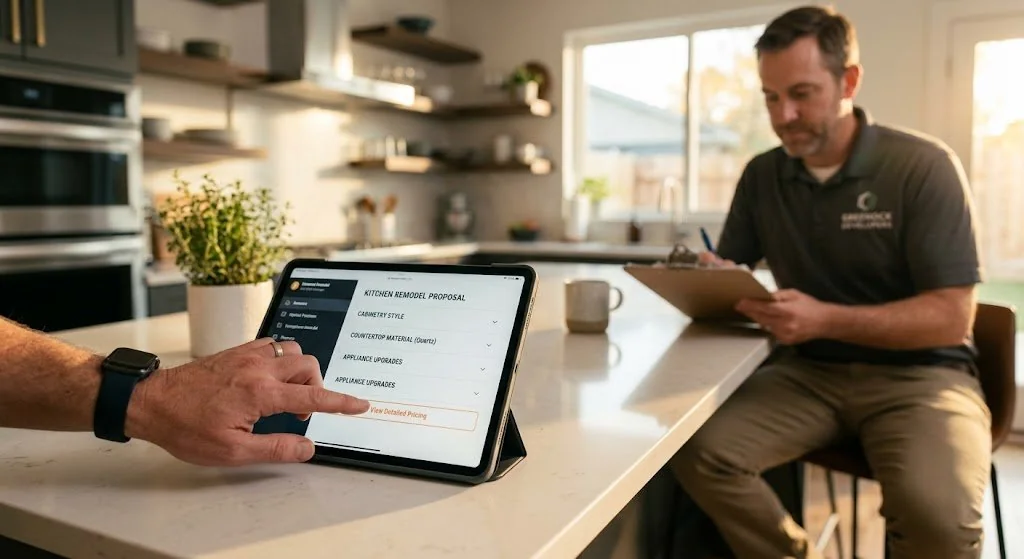
What works well: The interactive proposal hits all four bars: yes/no toggles, per-unit quantity steppers, live recalc with tax, and phone eSign. The customer-facing page is fully branded to the contractor's colors and logo. The math (subtotal, tax, total, deposit, balance) updates in real time as the customer changes selections.
What's missing: Atlas isn't trying to be a full field service management platform. There's no dispatching, no fleet tracking, no built-in payroll. If you need a one-platform-for-everything, Atlas isn't it. It's intentionally focused on the marketing-and-sales surface, not the operational backend.
Where it lands: Strongest fit if your business already uses something for ops (or doesn't need much) and you want the customer-facing proposal, website, and lead-capture pieces to feel modern. The proposal surface specifically is the most flexible of the four platforms compared.
The decision matrix
Per-unit quantity steppers: Atlas full support; others limited or contractor-set
Live recalc with tax/deposit: Atlas full; Jobber partial; Housecall Pro within tiers; ServiceTitan partial
Phone eSign: All four support
Branded customer page: Atlas full; others through their own brand wrapper
Which platform is right for which contractor
If you're running a 30+ tech HVAC company with complex dispatching needs: ServiceTitan, despite the proposal weaknesses. The operational tooling is what you're paying for, and the proposals get done at the kitchen table anyway.
If you're a 1-5 person home services shop and want everything in one platform: Jobber or Housecall Pro. Both are mature, well-supported, and handle 90% of what most small operations need. Pick Jobber if you want more customizable workflows; pick Housecall Pro if you want simpler setup and good/better/best proposals.
If you want the best customer-facing proposal experience and don't need full ops tooling: Atlas. The interactive configuration with per-unit steppers and live recalc is currently the strongest among the four, and the price point is the lowest.
If your customers are mostly configuring proposals on their phones at night, after work, alone: The platforms that prioritize the mobile-first interactive experience (Atlas, Jobber) close at meaningfully higher rates than the platforms that assume an in-home pitch. ServiceTitan was designed in a different era for a different sales motion.
The bottom line
Most home services software has a proposal feature. The differences are in the customer-facing experience and the upsell mechanics, not in whether the feature exists.
If your competitive edge depends on customers being able to configure their own scope, see the math live, and sign without a follow-up call, the platform you pick matters. If you're using your software primarily for ops and the proposal is just "send a quote and follow up by phone," any of the four work fine.
The trend is clear in either case: the days of static PDF proposals are ending. Customers expect to configure their own price the way they configure every other purchase in their life. Whichever platform you pick, picking one that handles this well is the call to make in 2026.