A 40-year-old security company in Edison, NJ sent a wireless system upgrade quote for $3,044. The customer opened the proposal on their phone, started picking through the optional add-ons, and signed it for $4,233.
That's a $1,189 lift on one job. A 39% bump above the original quote. Zero phone calls, zero scope-clarification emails, zero "let me check with my husband and get back to you" delays.
The contractor didn't pitch harder. The proposal didn't change. The customer just had a way to add things to it themselves: supplemental smoke detectors at $150 each, carbon monoxide detectors at $155 each, water leak detection at $205, and they did.
This is what a static PDF leaves on the table.
What's actually happening on the static-PDF version
The traditional contractor proposal looks like this: type the scope into Word, list the optional add-ons in a section near the bottom, export as a PDF, email it to the customer, then wait. The customer prints it, marks up what they want with a pen, scans it back, or calls to "talk through what's included."
Three things go wrong every single time.
The customer doesn't know what they cost. "Supplemental smoke detectors, $150 each, optional" means very little until the customer has to do the math against their own budget. So they don't. They just check the boxes they're sure they want and skip the rest.
The total never changes. The proposal says $3,044 at the top and $3,044 at the bottom, regardless of what add-ons the customer is mentally selecting. There's no tactile feedback. No "if I add this, my total goes to $X." Just a static number that feels final, even before the customer has decided.
The follow-up call kills the upsell. Customer calls back: "I want to add water detection but I'm not sure about the smoke detectors." Now you're on a 15-minute call talking through scope, doing math out loud, hoping you remember the right per-unit price. Half the time the customer just says "let's go with the original quote" because the conversation got too long.
Every contractor in home services knows this. Most have just accepted it as the cost of doing business.
What changes when the customer can configure their own price
The Korzeb proposal, let's keep using it as the example, had three optional add-ons:
1. Supplemental wireless smoke detectors at $150 per unit. Per-unit add-on with a quantity stepper (0 to 99).
2. Supplemental wireless carbon monoxide detectors at $155 per unit. Same stepper format.
3. Water leak detection package at $205. Single checkbox, on or off.
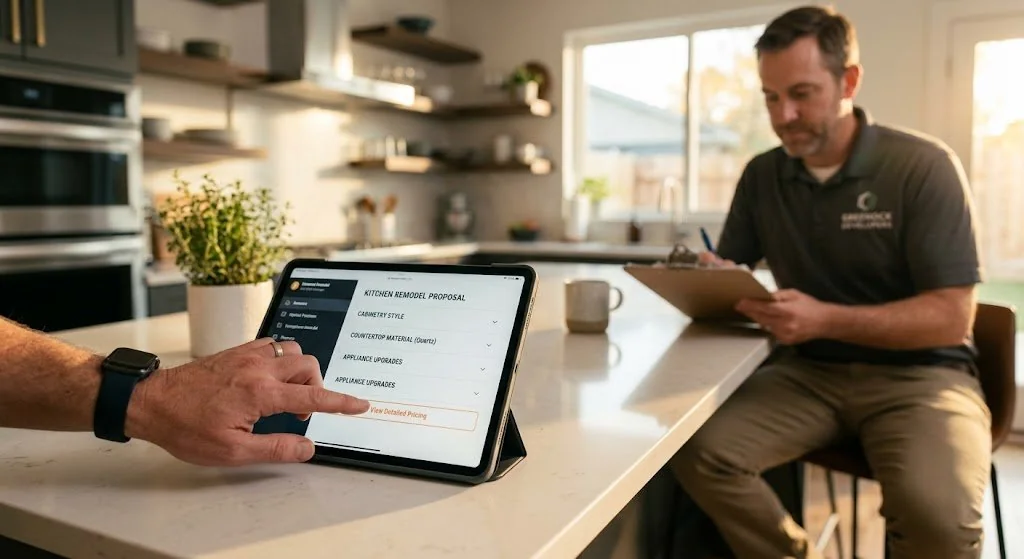
When the customer opens the proposal on their phone, all three options are unselected by default. The base subtotal reads $2,855. NJ tax at 6.625% is $189.14. Total at the bottom: $3,044.14.
The customer taps the "+" button next to the smoke detector option. Quantity goes from 0 to 1. The "Selected add-ons" line appears in the pricing summary, showing "$150.00." Subtotal updates to $3,005.00. Tax updates to $199.08. Total updates to $3,204.08.
They tap "+" three more times. Now there are 4 smoke detectors. Total reads $3,654.01.
They tap the carbon monoxide stepper twice. Total reads $3,973.94.
They flip the water detection toggle on. Total reads $4,193.51.
NJ tax reapplies on the new subtotal. Total reads $4,233.01.
They scroll down. The signature block already reflects the new total. They sign with their finger. The contractor gets an email two seconds later: "Scott Korzeb signed Proposal #5030 for $4,233.01."
Why the upsell rate is higher than a contractor would do manually
If you handed that same customer a paper proposal and said "do you want any of these optional add-ons?" the answer would almost always be "let me think about it." The friction of saying yes to extras: in front of a contractor, on a phone call, with the social pressure of being upsold, is enormous.
The friction of moving a quantity stepper from 0 to 1 on your own phone, alone, in your own time, is roughly zero.
That's the entire mechanism. You're not pitching the customer. The customer is exploring the menu. They're in the same psychological mode they're in when they add things to an Amazon cart, configure a Tesla on the website, or upgrade their seat on a Delta flight. They don't feel pitched-to. They feel in control.
Every modern e-commerce experience figured this out 15 years ago. Static PDF proposals are the last holdout in B2C and home services. The contractors who switch first to interactive proposals capture the upsell. The ones who don't keep losing it to "we'll go with the base package, thanks."

The math at scale, not just on one job
One $1,189 lift on one proposal isn't a business case. The business case is what happens when you do this on every proposal you send for the next year.
Take a security/fire-alarm contractor sending 80 proposals a year, with an average base quote of $3,500. Conservative assumptions:
Without interactive proposals: 12% of customers add an optional item, average add of $200. Annual upsell revenue: 80 × 12% × $200 = $1,920.
With interactive proposals: 35% of customers add at least one item, average add of $850 (because the steppers make it easy to add multiples). Annual upsell revenue: 80 × 35% × $850 = $23,800.
That's a $21,880 swing per year, off the same proposal flow. No new leads, no new advertising, no extra sales effort. The same customers, the same base quotes, configured differently.
For a roofer sending 40 proposals a year at $12,000 average, the math is bigger. For an HVAC company sending 200 proposals a year at $9,500, the math is enormous.
The signature side of the equation
The piece that closes the loop, and the piece most contractors don't realize matters, is the eSign. The customer doesn't need to print, sign, scan, email back. They tap their finger to draw a signature, hit submit, and the deal is done.
Median time from proposal-sent to proposal-signed for a static PDF + paper-sign workflow: 4 to 7 days. Median time for a phone-eSign-able branded link: under 24 hours.
Faster signs mean fewer cold-feet cancellations. Fewer "can we revisit this in the spring" delays. Fewer customers who fully meant to sign but never got around to it because the workflow had four steps.
Combined with the upsell mechanic, you get two compounding effects: customers add more, and they add more faster. The contractor's deposit lands in their bank account on Wednesday instead of next Tuesday.
What this looks like to set up
The Korzeb proposal we keep referring to was built on Atlas's proposal system. Three controls per option: quantity stepper, single checkbox, or default-on with toggle-off. Each option has a per-unit price, a max quantity cap (so the customer can't accidentally select 99 smoke detectors), and a tax flag (so the math works correctly in jurisdictions where some line items aren't taxable).
Setup time per proposal: about 90 seconds longer than building the equivalent static PDF, mostly because you're listing optional items separately from the base scope. After the first one, it's faster than a PDF because you stop having to manually total everything yourself.
The customer-facing page is a branded URL, something like /p/677c3ad1f9cb6d16e96ce0d9ee228661. That the contractor copies and pastes into a text message or email. The customer taps it on their phone, sees the proposal in the contractor's brand colors, configures their selections, and signs.
Everything writes back to the proposal database: which options were selected, the final subtotal/tax/total/deposit, the signature, the timestamp. The contractor's accounting and the customer's invoice match exactly because they were generated from the same numbers.
The thing that keeps surprising contractors
It's not that customers add a few items to bump the total. You'd expect that. The surprise is how often customers add things the contractor wouldn't have thought to pitch.
The Korzeb job was a wireless security upgrade. The contractor was focused on the new control panel, the door sensors, the motion detectors. The water leak detection package wasn't something he was actively selling. It was just listed as an option.
The customer added it. Why? They had a finished basement they were nervous about. The contractor never would have known to ask, because that wasn't the conversation they had at the walkthrough.
Static PDFs hide the menu. Interactive proposals show it. And the moment you show customers everything available, a meaningful percentage of them pick things you didn't pitch and didn't expect.
That's the real story. The 39% lift on the Korzeb job isn't a one-off. It's a structural feature of letting customers configure their own price.
Bottom line
If you're sending static PDF proposals, you're leaving 20-40% of your potential ticket on the table. Not because your customers don't want to spend more. Because the format you're using makes it inconvenient for them to.
The fix isn't sales training. The fix is the proposal format.