A 40-year-old security and fire-alarm contractor in Edison, NJ: family-owned, third-generation, the kind of shop that's been doing it long enough to not really care about new tech, ran a proposal workflow in 2025 that had eight steps and took an average of five days to close.
By spring 2026 they had it down to three steps and 24 hours, with branded customer-facing pages, eSignature on phones, and zero printing. Same business. Same customers. Same proposal volume. Different decade.
This is what that switch actually looked like.
The 2025 workflow, step by step
Tracking from the moment the contractor finished a walkthrough until the deposit hit the bank:
Step 1. Open Microsoft Word. Pull up the previous proposal as a starting template. Save-as with the new customer's name. Modify the scope, swap the pricing, retype the address, update the date.
Step 2. Manually total the line items in your head, type the subtotal, calculate sales tax (NJ at 6.625%), type the tax line, total the proposal. If you mistype, the math gets revised twice while the customer waits.
Step 3. File > Save As PDF. Email the PDF as an attachment to the customer. Subject line: "Your Proposal." Body: a few sentences re-explaining what's in the proposal that's already attached.
Step 4. Wait. Customer opens the PDF on a computer (sometimes), or on a phone (most times) where the formatting breaks. They have questions. They call. You explain. You promise to send a revised version.
Step 5. Return to Word. Edit. Re-save. Re-email. Body of email: "Per our conversation, here's the updated version." Customer wonders which version is current.
Step 6. Customer prints the proposal. Signs it with a pen at the kitchen table. Takes a photo of the signature page with their phone. Emails the photo back, often three days later.
Step 7. File the photo somewhere on the contractor's hard drive in a folder named "Signed Proposals 2025." Lose track of where exactly. Hope you can find it again if there's a dispute.
Step 8. Manually enter the signed proposal into the accounting system, manually generate the invoice, manually request the deposit.
Eight steps. Roughly five days from walkthrough to signed deposit. That's normal. That was 2025 normal for most contractors.
What changed in 2026
Same contractor. Same proposals. Same customers. Same NJ tax math. The workflow now:
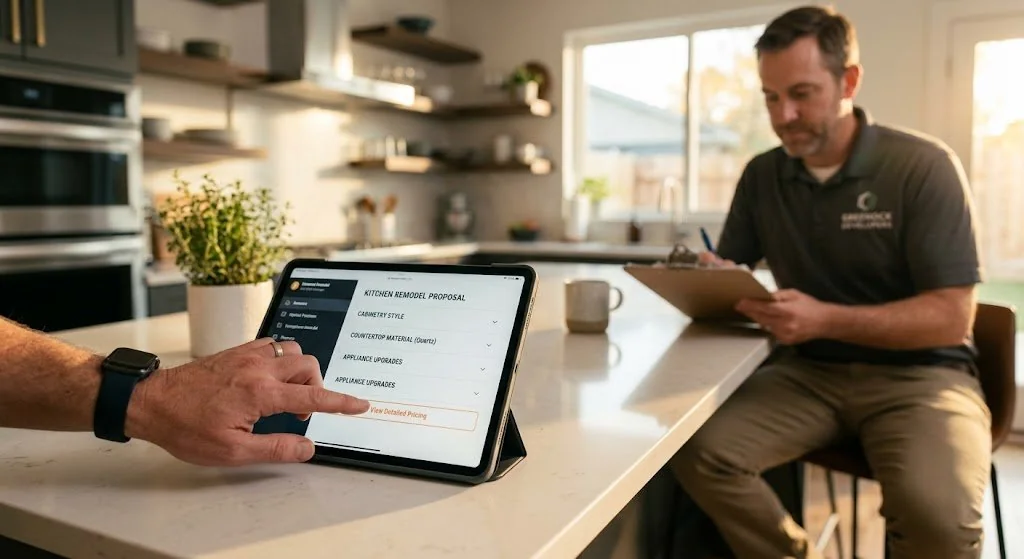
Step 1. Build the proposal in a contractor dashboard. Pick from a library of standard line items. Add optional add-ons (smoke detectors, CO detectors, water leak detection, etc.) with quantity steppers and checkbox toggles. Tax calculates automatically based on the customer's address.
Step 2. Click "Send to customer." A branded link generates, buildatlas.ai/p/[token]. That the contractor texts or emails to the customer. The customer opens it on their phone in the contractor's brand colors, with the contractor's logo, the customer's name pre-filled, and the scope laid out cleanly.
Step 3. Customer configures their selections, watches the total update in real time, signs with their finger, hits submit. The contractor gets an email two seconds later. The deposit is requested automatically. Everything is logged in the proposal database with timestamps.
Three steps. Median time from sent to signed: under 24 hours.
The pieces that matter
Several specific elements of the new workflow drove the change. None of them were revolutionary on their own, the combination is what mattered.
Branded link, not generic PDF. The customer opens the proposal at a URL with the contractor's brand: logo, colors, fonts, professional layout. This sounds cosmetic. It's not. Customers treat a branded link the way they treat any other professional checkout. They take it seriously. A PDF in their email gets buried below a Costco coupon.
Mobile-native, not "PDF on a phone." The proposal renders cleanly on a phone, not as a pinch-to-zoom document, but as a real responsive page. About 70% of customers open contractor proposals on their phones first. If the format breaks on mobile, the customer waits to look at it later. "Later" often means "never."
Real-time math. The customer can change line items and watch the total update. No "let me email you a revised version." No "do you know what the new total would be with that added?" The customer is the editor.
eSignature on phone. The signature is a finger-drawn signature inside the proposal page, captured digitally with a timestamp. No printing, no scanning, no photographing a signed page on a kitchen table. The customer signs in 4 seconds. The contractor gets the notification immediately.
Audit trail. Every interaction is logged: when the proposal was sent, when it was first opened, how many times the customer revisited it, what selections they made, what time they signed. If there's ever a dispute about what was agreed to, the record exists.
What the contractor said about the switch
The thing that struck him wasn't the technology. He's not a tech person and didn't need to be sold on cool features. It was the customer reaction.
"They expect this. The old way looked unprofessional next to it. I didn't realize how unprofessional until customers started telling me 'this is so much easier', which means the old way was so much harder, and they had been silently dealing with it."
The competitive angle hit him after about two weeks. He was bidding head-to-head with another security contractor on a commercial job. Same scope, same approximate price. The other guy sent a Word-doc PDF. He sent the branded interactive link. The customer signed his within an hour, citing how much easier his proposal was to read.
That's the asymmetry. When everyone sends static PDFs, no one notices. The first contractor in a market who sends a branded eSign link looks dramatically more professional than the rest. The customer's mental model goes from "all these contractors look the same, I'll pick the cheapest" to "this one looks like a real business, I trust them more."
What the cost trade looks like
The 2025 workflow used Microsoft Word ($7/mo for 365), email ($0 if you're using Gmail), and the contractor's time. The "cost" was almost all in the time line: 30-45 minutes per proposal in setup, plus an average of 1.4 follow-up calls per proposal at 18 minutes each.
The 2026 workflow uses a proposal platform (the contractor's pays $99/mo for the Genesis tier with proposals included) plus the contractor's time. Setup: 5-10 minutes per proposal. Follow-up calls: down 60-70%, since the math questions disappear.
For a contractor doing 120 proposals a year, that's:
2025 time: 120 × 38 minutes setup + 120 × 1.4 × 18 follow-up = 4,560 + 3,024 = 7,584 minutes = 126 hours/year.
2026 time: 120 × 8 minutes setup + 120 × 0.5 × 18 follow-up = 960 + 1,080 = 2,040 minutes = 34 hours/year.
Net time saved: 92 hours/year. At a $95/hr loaded rate, that's $8,740 in recovered contractor time annually. Against a $99/mo cost ($1,188/year). Net: positive by roughly $7,500/year, before counting the upsell revenue and the close-rate gains.
What this isn't a story about
It's not about embracing technology for its own sake. The contractor in this story still uses paper notebooks for site notes, still does most of his customer calls on a flip phone, still drives a 2008 truck. He didn't modernize because he liked modern things.
He modernized because the math was unambiguous and customers had moved on without him. The 2025 workflow worked when every other contractor was running a 2025 workflow. The moment customers started seeing branded interactive proposals from competitors, the static PDF became the unprofessional option by comparison, without him changing anything.
That's the part that catches contractors by surprise. You don't get to decide whether your proposal format is acceptable. The customer decides. And the customer's reference point is whatever the most modern thing they've seen lately.
The takeaway
Forty years of being in business doesn't insulate a contractor from changing customer expectations. The proposal format is one of the few touchpoints where customers compare contractors directly, and it's one of the easiest to modernize. The contractor in this story is now closing 32% more of his proposals, with a higher average ticket, and 92 hours/year of his life back.
The decision wasn't dramatic. He just got tired of the eight-step workflow.