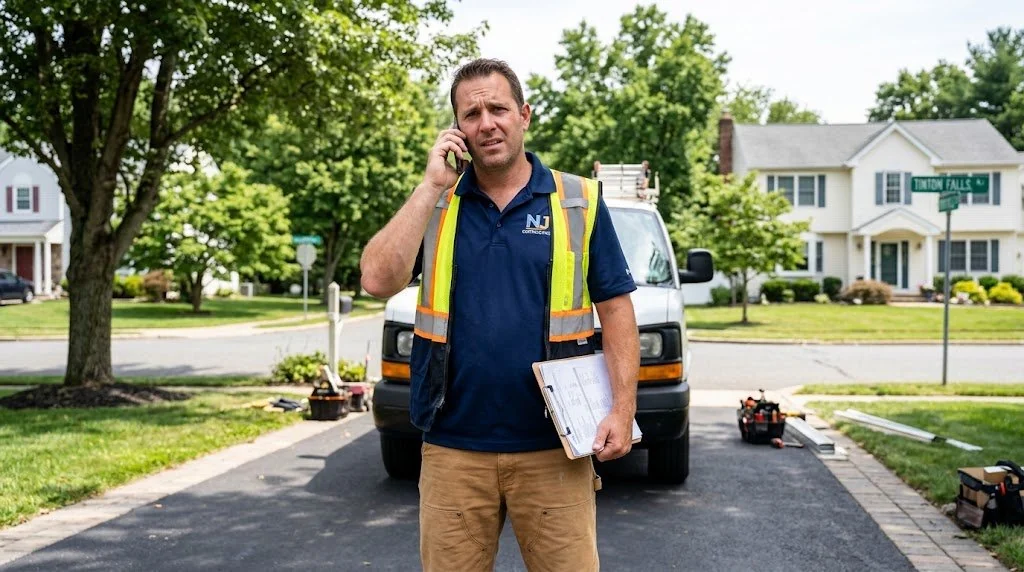
Every time you send a quote, you're starting a clock. The customer reads it. They have a question. They call you. The call lasts 12-22 minutes. You explain scope. You re-state pricing. You promise to send a revised version. You hang up, get pulled into the next thing, and forget about the revision until tomorrow.
That cycle, the one most contractors don't track because it doesn't show up on any line item, is one of the largest hidden costs in a service business. Add it up across a year and it's bigger than most marketing budgets.
Let's actually do the math.
The 90/10 rule of proposal questions
About 90% of customer questions on a proposal are scope-clarification, not price-negotiation. They're not trying to talk you down. They're trying to understand what they're buying.
"Does this include the permit?" "Are the smoke detectors hardwired or battery?" "Is the disposal of the old unit included or do I need to figure that out?" "How much would it be to add water leak detection in the basement?"
Each of these takes a 15-minute call to answer. The contractor knows the answer in 30 seconds. The other 14 minutes are: greeting, finding the proposal, walking through it line-by-line, doing math out loud, answering 2-3 follow-up questions, repeating the next-steps, and saying goodbye. That's a normal human conversation, not a sales failure. It's just expensive.
The annual time math for a typical home services contractor
Take a roofer doing 80 proposals a year. Conservative numbers:
Per proposal: 1.4 follow-up calls on average. Some get 0, some get 3, the average is around 1.4.
Per call: 18 minutes from "hello" to "thanks, talk soon."
Annual time on follow-up calls: 80 × 1.4 × 18 = 2,016 minutes, or 33.6 hours.
That's almost a full work-week of pure scope clarification. Spread across the year it's barely visible. Compressed into one block, it's enormous.
Now scale that up. A bigger HVAC company doing 200 proposals/year hits 70 hours of follow-up calls. A security and fire-alarm contractor doing 120 proposals/year is at 50.4 hours. Big plumbing operation? Easily 100+ hours.
None of this shows up on a P&L. There's no "follow-up call" line item. It just sits inside the contractor's day, eating focus.
The hidden second cost: deals that get cold while you're calling back
The bigger problem isn't the time you spend on calls. It's the time the customer waits for the call.
Customer reads the proposal Tuesday morning. Has a question. Calls or texts the contractor. Contractor is on a job, can't pick up. Calls back Wednesday afternoon when the customer is at work. Customer calls back Thursday evening. Contractor is at dinner with family. Phone tag continues into the weekend. By Monday, the customer has already gotten a quote from another contractor and is leaning the other way.
Industry data on this is consistent: every 24-hour delay in responding to a proposal question correlates with a 5-7% drop in close rate. Not because the customer changed their mind, because momentum decayed.
Static-PDF proposals create the conditions for momentum decay. The customer can't get an answer without the contractor on the phone. The contractor can't always get on the phone. The deal goes cold.
What questions interactive proposals eliminate vs. what they don't
Not every proposal question goes away with an interactive format. Let's separate them.
Questions that disappear with interactive proposals:
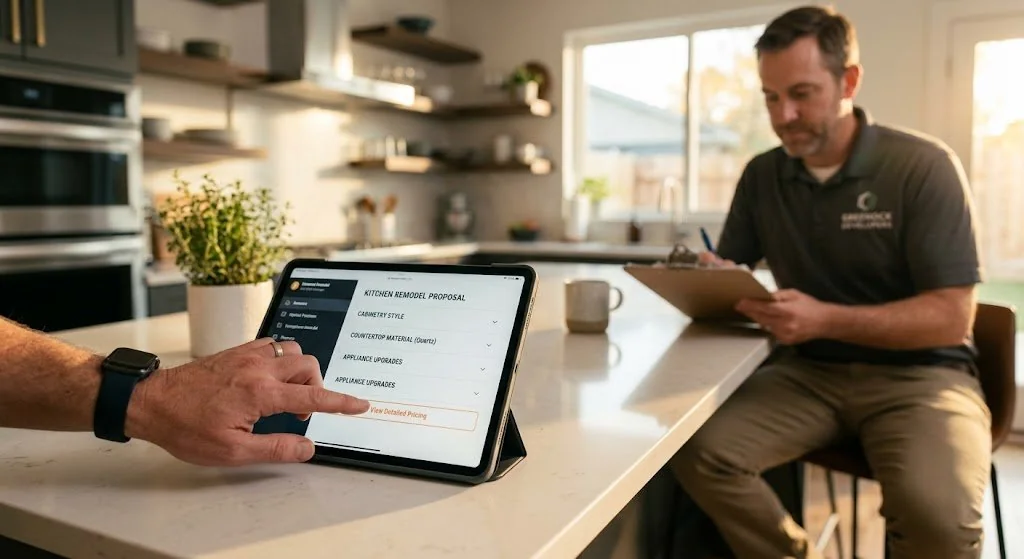
"How much would it cost to add X?" Customer can see exactly. They don't ask. They just toggle.
"What's the total if I take out Y?" Customer can see exactly. They unselect Y, watch the total drop, decide.
"Can I get a revised version with these add-ons?" The proposal IS the revised version. Selections are saved. The signed version reflects whatever the customer configured.
"What does the deposit work out to with the new total?" Deposit recalculates automatically as the customer changes selections.
"Is sales tax included or extra?" Tax line shows up explicitly and updates with every change.
Questions that don't go away:
"How long does install take?" That's a real conversation. Worth picking up.
"Do you have references in my neighborhood?" Same.
"What happens if there's a permit issue?" Same.
"Can you start before next Friday?" Same.
The math questions disappear. The judgment questions remain. That's the right split. You should be on the phone for the second category, not for "how much extra is one more smoke detector."

What time you get back, in practice
Take the same roofer at 80 proposals/year. About 60% of follow-up calls are math questions. Eliminating those drops follow-up time from 33.6 hours/year to about 13.4 hours/year. That's 20 hours of contractor time recovered annually.
20 hours might sound modest. But it's 20 hours of focused work the contractor wasn't getting before. That's two and a half full workdays. Spent on jobs, on bigger sales conversations, on running the business. Or just spent at home with family, which has its own value.
The bigger company is the bigger savings. A 200-proposal HVAC shop recovers ~42 hours/year. A 500-proposal plumbing operation recovers ~100+. The math compounds with scale.
What it actually feels like to run a business this way
The thing that surprises contractors after switching to interactive proposals isn't the upsell revenue or the close-rate bump. Those are real, but they show up as numbers.
What surprises them is how much quieter their phones get.
The "did you have a chance to look at that estimate?" follow-up text doesn't need to happen, because the customer can see the proposal status (viewed, not viewed, partially configured, signed). The "let me explain what's included" call doesn't need to happen, because the proposal includes a line-item description for every option. The "I'll send you a revised version" promise doesn't need to happen, because the customer revises the proposal themselves by toggling options.
What's left on the phone is conversations that actually need a human voice: scheduling, judgment calls, references, complex jobs that don't fit the configuration model. Those conversations are higher-value, less common, and easier to focus on when they're not buried in 8 daily calls about smoke detector pricing.
The bottom-line trade
Static PDF proposals look free. They're not. The cost just shows up in different ledgers: contractor time, deals lost to delay, missed upsell, and the diffuse drag of context-switching across multiple proposals at once.
Interactive proposals push that cost back where it belongs, at the moment of building the proposal. You spend an extra 90 seconds setting up the optional line items. In return, you skip almost every scope-clarification call for the life of that proposal.
For a roofer at 80 proposals a year, that trade is: 90 extra seconds × 80 = 2 hours invested up front, against ~20 hours of phone-tag avoided. A 10x return on the time investment, paid out across the year.
The math gets better as you do more proposals. The hidden cost was always real. Modern formats just make it visible.