Social media is where customers find businesses now
Start with the discovery numbers, because they're bigger than most owners assume. 58% of consumers report discovering new businesses on social media, a rate that industry analyses now put ahead of traditional search and TV for brand discovery. For local businesses specifically, 73% of consumers use social media at some point while researching a local business. The feed isn't a side channel. For a growing share of your next customers, it's the front door.
And discovery converts. 63% of consumers say they make plans to visit a business after a positive interaction with it on social media. 76% say they've purchased something they discovered on social. Customers who follow a business spend measurably more with it over time. The pipeline from a post to a paying customer is longer than an ad's, but it's real, and it's documented.
The consistency effect is measurable
Here's the part that matters more than any single viral post. Buffer's research found that accounts posting irregularly see roughly 40% lower reach than consistent posters, and that consistency of schedule matters more than posting at the perfect time. Hootsuite's data points the same direction: accounts posting regularly earn multiples of the engagement of accounts that post in bursts and go quiet.
The mechanism is simple. Social algorithms distribute content from accounts that reliably produce it, and audiences build a habit around accounts they reliably see. Post steadily and both compound in your favor. Post in January, vanish until April, and you restart from zero, except the algorithm remembers the silence.
That's why the practical benchmark isn't heroic. Two to five posts a week, kept up indefinitely, is the working range most research supports, and it's what the majority of active small businesses actually do. The businesses losing on social aren't the ones posting three times a week instead of seven. They're the ones posting zero.
Want to see how visible your business is across Google and AI search? Run your site through our free AI-era SEO audit. You get a scored report of exactly what to fix, emailed in minutes. No sales call attached.
Run the free audit →The dead feed problem
There's a second cost to inconsistency that no platform metric captures: what a silent feed says to the customer who checks it. And they do check. A homeowner comparing two contractors looks at the feeds the same way they look at reviews, asking one question: is this company alive and busy? A feed of recent jobs says yes. A last post from four months ago plants the same doubt as a phone that rings out.
This is also increasingly machine-read. AI assistants evaluating local businesses pull from public signals including social presence, so an active, consistent feed feeds the same visibility engine as your website and your reviews. The full picture of that shift is in our AI search guide.
Why most businesses can't keep it up, and what actually works
None of this is news to owners. The reason feeds die isn't ignorance, it's arithmetic: doing social properly consumes hours every week, on top of running the actual business. Content is a part-time job, and most owners already have one of those stacked on a full-time one. So it gets done badly, then sporadically, then not at all, which the reach data above turns into a measurable penalty.
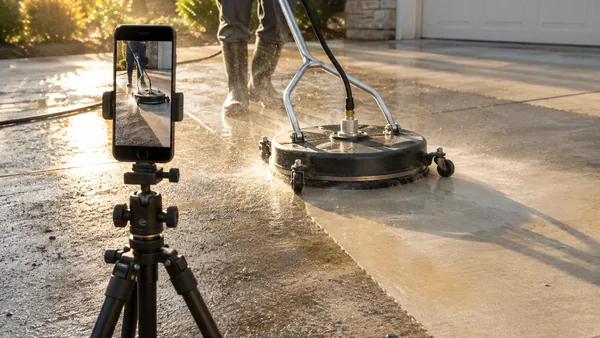
The businesses that win this pick a system they can sustain: a fixed posting rhythm, content built from what the business already produces (job photos, before-and-afters, finished work), and short-form video where the organic reach currently is, which we've broken down in why short-form video works for local service businesses. Some build the habit in-house. Some hand it to a service built for exactly this. Either way, the bar the data sets is refreshingly low: show up, steadily, with real work. The numbers do the rest.
Common questions
Does posting on social media actually bring in customers?
The discovery numbers say yes: 58% of consumers report discovering new businesses on social media, 73% use social platforms while researching local businesses, and 63% make plans to visit a business after a positive interaction with it. For local companies, social is a discovery channel, not just a branding exercise.
How often should a small business post?
Two to five posts a week is the widely cited working range, and most active small businesses post multiple times per week. The bigger finding is that regularity beats volume: research shows accounts that post irregularly see roughly 40% lower reach than consistent posters, so a sustainable schedule you keep beats an ambitious one you abandon.
Why does a dead social feed hurt a business?
Because customers check it the way they check reviews. A feed whose last post is months old reads like a business that might not answer the phone. It also starves the algorithms: consistent activity is favored in distribution, so silence compounds into invisibility.
What kind of content works best for local businesses?
Real work, shown often. Short-form video is currently the highest-reach organic format available to small businesses, and job photos and finished projects consistently outperform generic promotional graphics because they prove the business is active and good at what it does.