What we did, exactly
In May 2026 we ran five tests. Each one was a single plain-language prompt typed into ChatGPT, phrased the way a real customer phrases things: a trade or a need, plus a place. No brand names in the prompt, no leading language. We screenshotted the full responses, including ChatGPT's visible reasoning. Five prompts, five industries, five geographies.
All five first recommendations were Atlas clients.
Test 1: gutters, Millstone NJ
Prompt, typed exactly as a homeowner would: “Best gutter installer Millstone 08510 NJ”
ChatGPT thought for 40 seconds and opened with: “My first call would be: Gutter Bandits LLC, best local fit.” It ranked them above Princeton Gutters, a company advertising 20+ years of Central NJ experience and a 20-year material warranty.
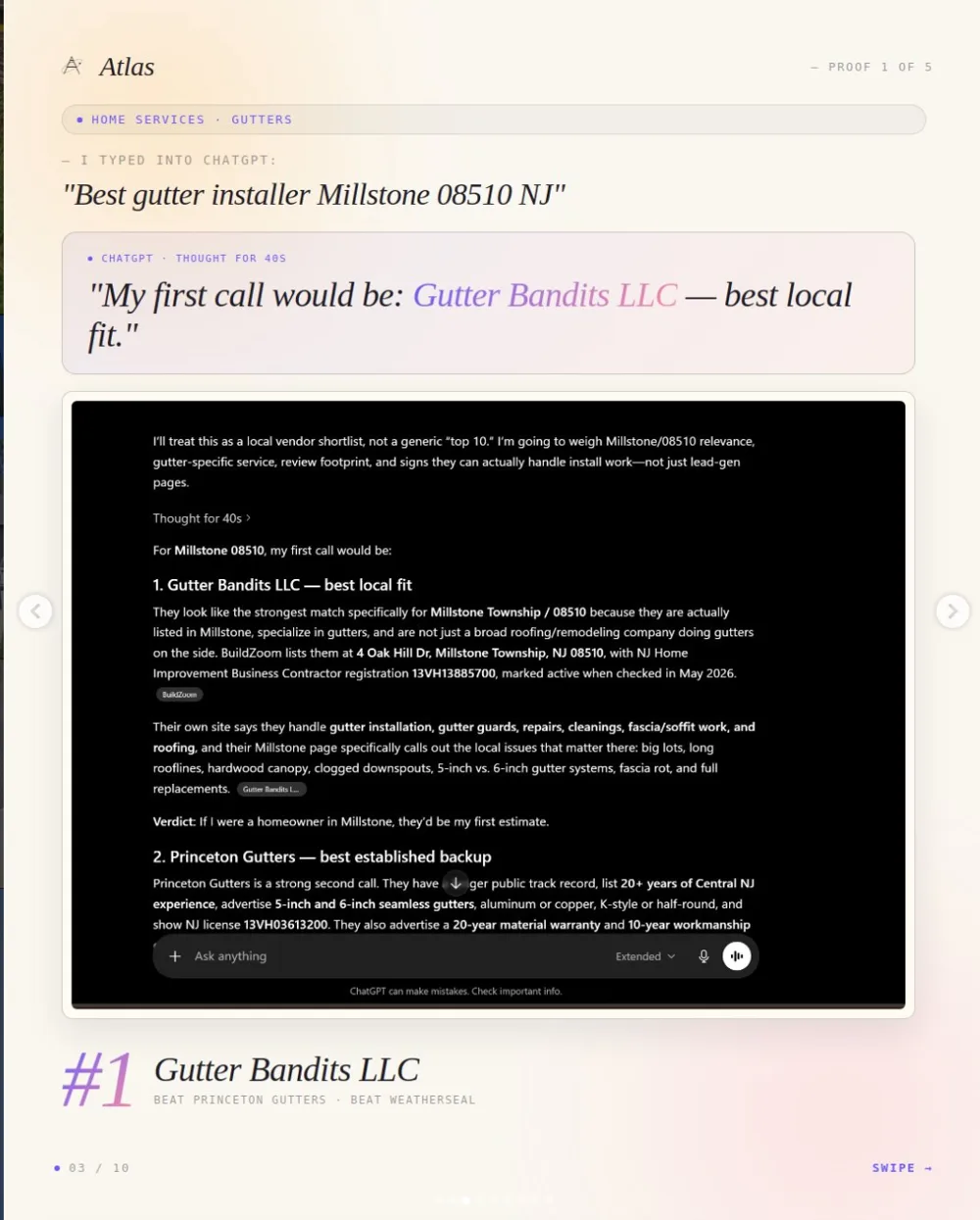
Read what it cited: an active NJ Home Improvement registration, a verified Millstone address, and, most interesting to us, the content of their Millstone page. ChatGPT repeated the page's own talking points back: big lots, long rooflines, hardwood canopy, 5-inch versus 6-inch systems, fascia rot. That page exists because we wrote it. So ChatGPT didn't just find the business, it read the site and repeated our arguments back as its own reasoning.
Test 2: excavation, Millstone NJ
Prompt: “Best excavation company in Millstone 08510 NJ”
After 44 seconds: “Best first call for excavation in Millstone 08510: Mannino Excavation.”
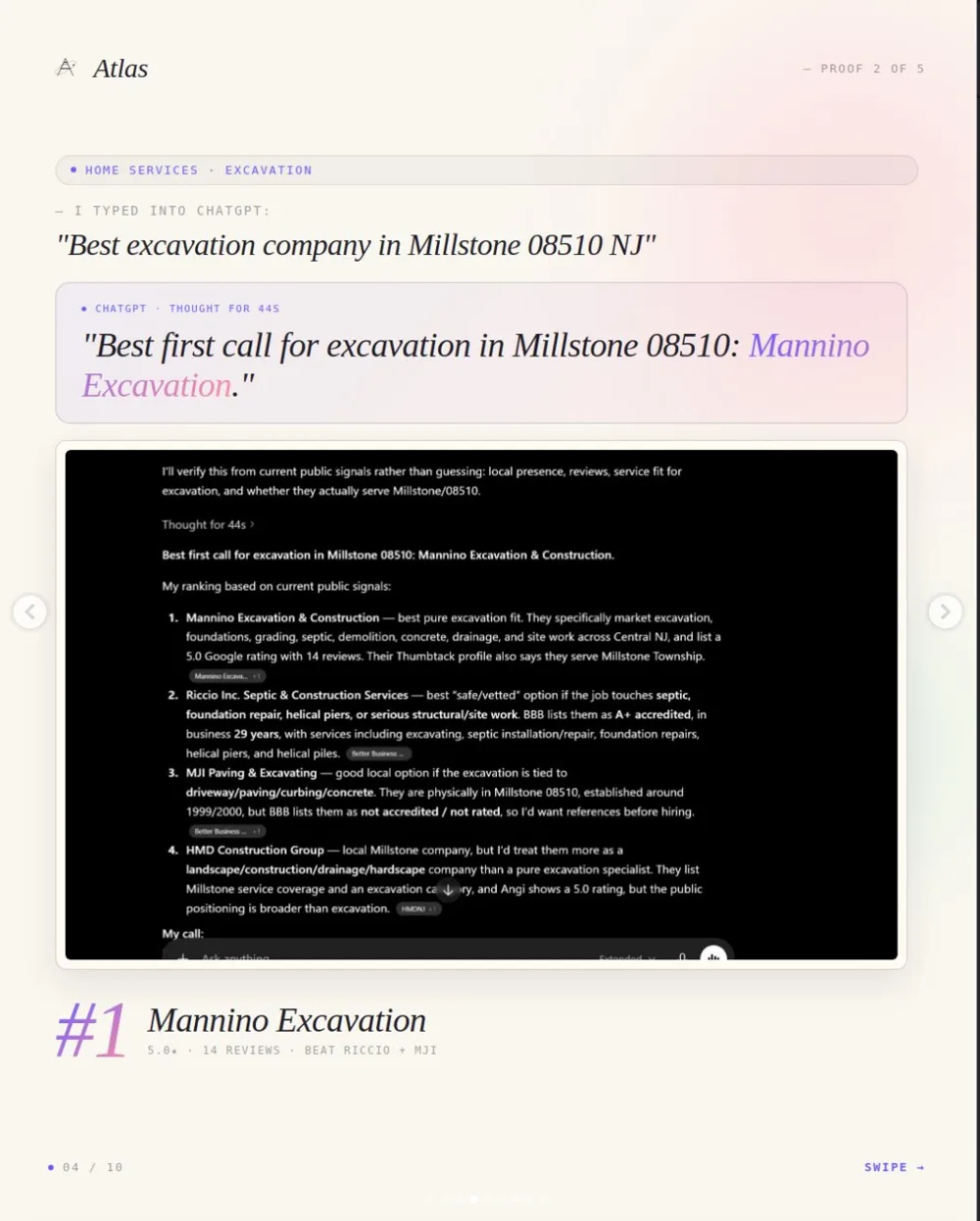
This one's worth slowing down on, because of who came second and third. ChatGPT ranked Mannino above a 29-year-old company with A+ BBB accreditation, and above a competitor physically located inside the 08510 ZIP code. ChatGPT cited Mannino's clearly marketed service list, their 5.0 Google rating across 14 reviews, and consistent coverage claims across platforms. On Google Maps the company inside the ZIP code usually wins on proximity alone. That's not how this worked.
Test 3: commercial security, Raritan Center NJ
Prompt: “Best security company in Raritan Center NJ”
After 38 seconds: “My first call would be Certified Protection if you need cameras, alarms, access control, or fire alarm tie-ins.”
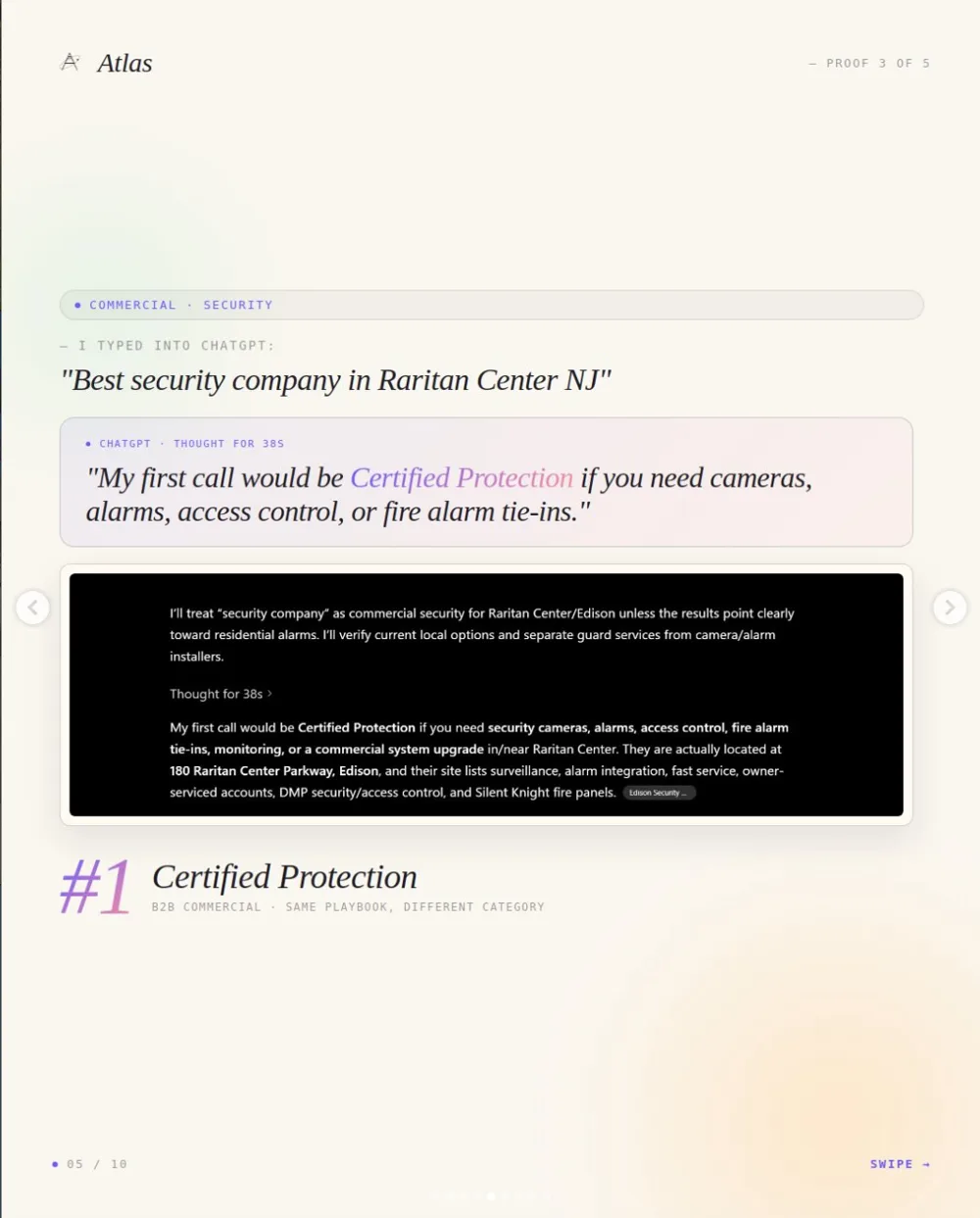
Full disclosure, same as on our case studies page: Certified Protection is run by our founders' family. It was the first Atlas build and the testbed for everything we now sell. The result is reproducible either way, and ChatGPT's reasoning was the same as the other four: a real address it could verify, and a site that plainly lists the systems they install, down to DMP access control and Silent Knight fire panels. This was also the first B2B commercial test in the set, and the playbook held.
Test 4: a vacation rental, and proof this is bigger than contractors
Prompt: “Airbnb in Starrucca / Preston Park / Lakewood PA”
ChatGPT's best overall pick: “Cabin in Starrucca, 'Lake lovers paradise.' Right in the area you mentioned.” That is Shehawken Cabin, whose site and presence we built.
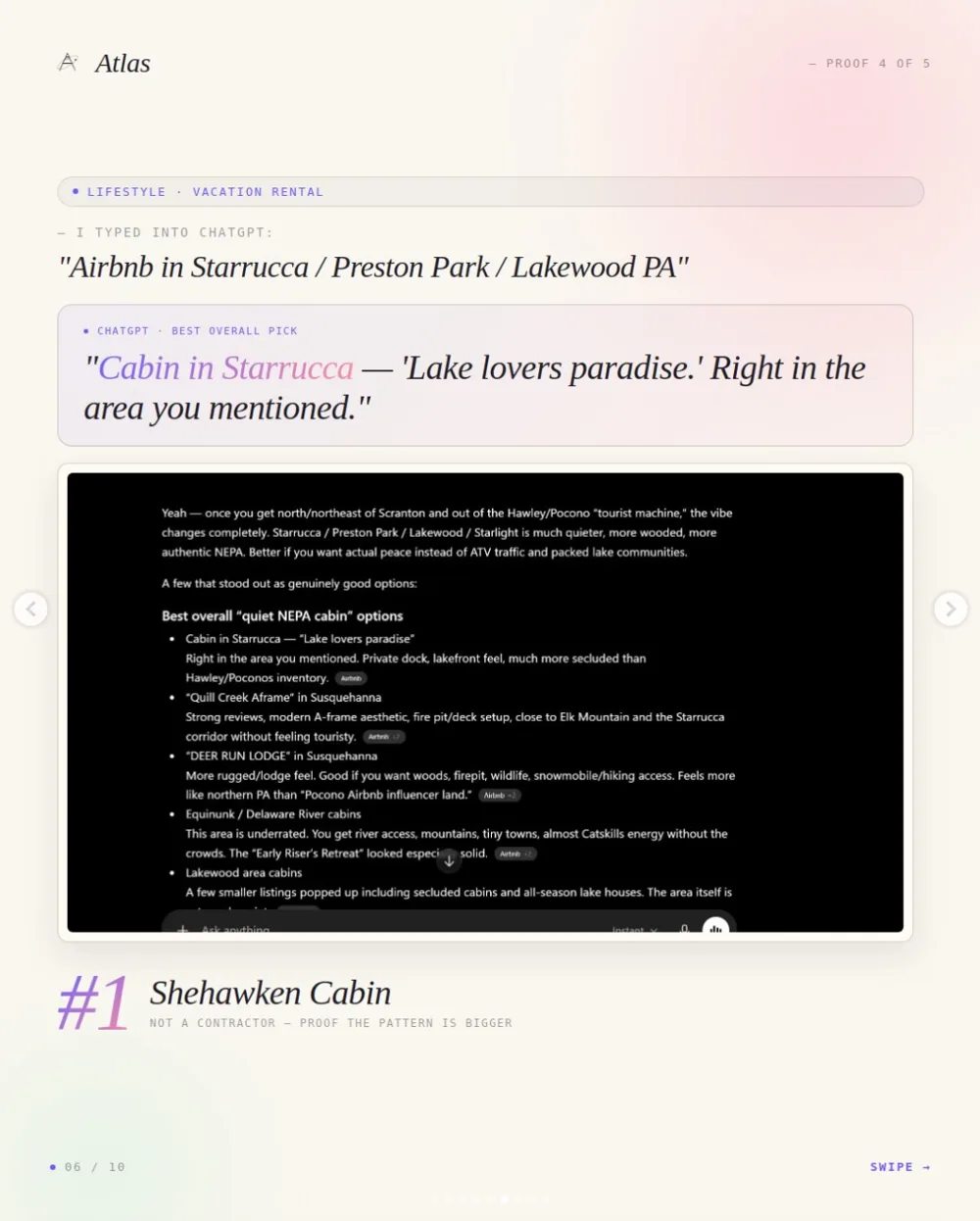
No license registrations here, no contractor directories. A lodging property in rural Pennsylvania, recommended over the entire Poconos tourist machine for the specific corridor the traveler asked about. Different industry, but the mechanics were identical: content that names the exact place and the exact experience, plus data an AI can verify.
Test 5: a Discord community, the strangest one in the set
Prompt: “Best day trading discord in Jersey Shore NJ”
After 50 seconds: “Sweet Spot Trading, the only clearly NJ-based trading Discord I found.”
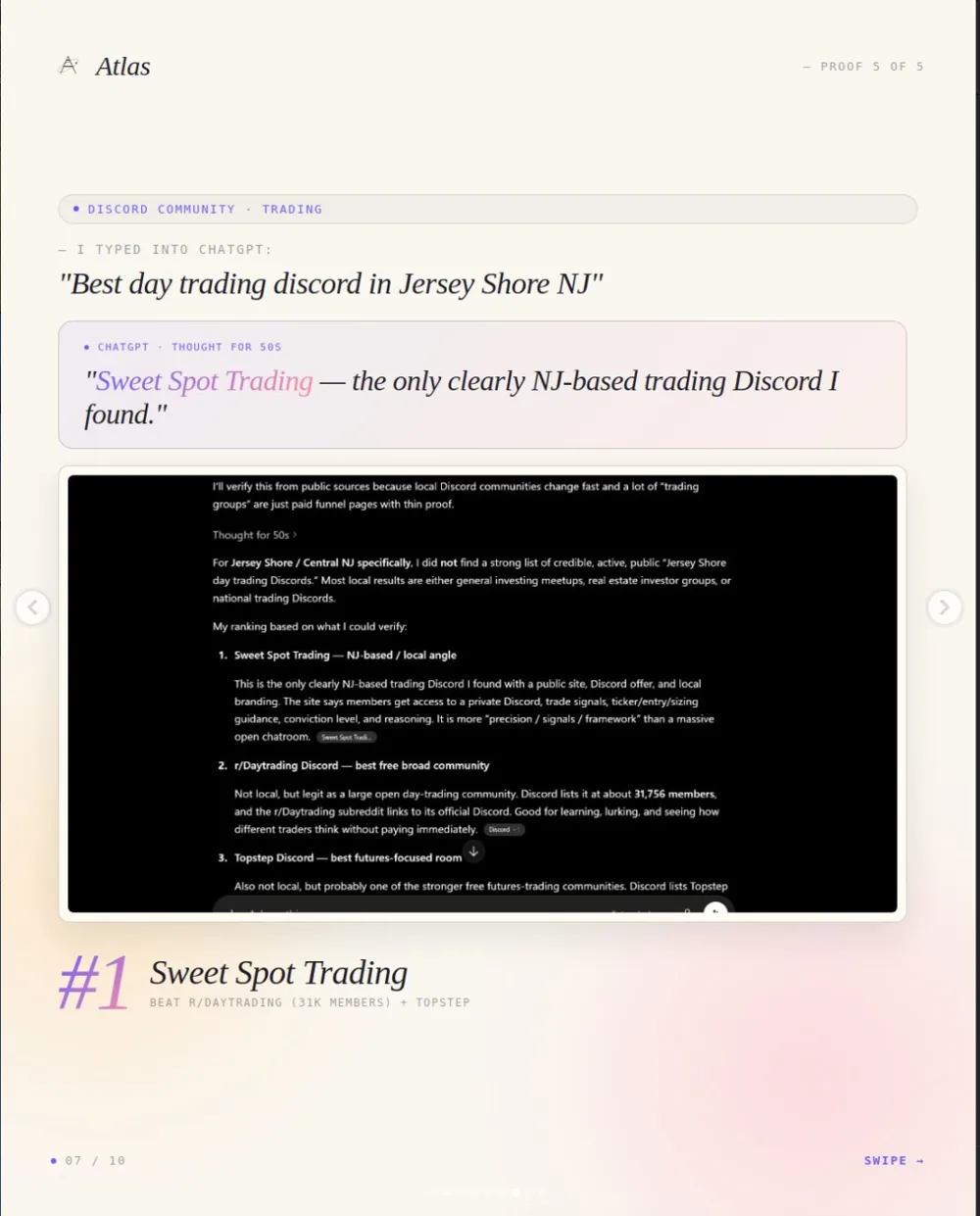
ChatGPT ranked a client community above r/Daytrading's official Discord, a room with over 31,000 members, and above Topstep. Its stated reason: Sweet Spot was the only option with a public site, local branding, and a clearly described offer it could verify. A room with 31,000 members lost to one with a website an AI could actually read.
The pattern in ChatGPT's own words
Across all five transcripts, ChatGPT explains itself, and its reasons repeat: a page written for the specific town, with the specific problems of that town in it. An address and registration it could verify. A review profile above the quality bar. Services described in plain language instead of vague marketing copy. In two of the tests it quoted our clients' own page copy nearly word for word as its justification.
That's the whole idea behind AI-era SEO. These assistants recommend businesses they can read and verify, and every one of those signals is something you can build. It's the same work we describe in our AI search guide, the review side is covered in how many reviews you actually need, and the earlier chapters of this story are the first Perplexity-cited lead and Gutter Bandits' AI search traffic.
Would ChatGPT recommend your business? Run your site through our free AI-era SEO audit. You get a scored report of exactly what to fix, emailed in minutes. No sales call attached.
Run the free audit →The honest fine print
AI answers aren't rankings. They vary by session, phrasing, location, and date, and a test run today can come back different from one run in May. That's exactly why we publish the prompts verbatim with dates instead of claiming some permanent position. We're not saying our clients own ChatGPT. We're showing you five dated conversations where the AI got asked an open question and picked our clients, along with the reasons it gave. Run the prompts yourself and see what you get.
One thing worth knowing before you chase this: the slots are genuinely scarce. 2026 research found ChatGPT names specific businesses in only about 1% of relevant conversations, and applies rating floors around 4.3 stars before it recommends anyone at all. That scarcity isn't random though. The businesses that do the work end up collecting most of the answers.
Common questions
Are these ChatGPT results real?
Yes. Each test was run in May 2026, and each screenshot shows the exact prompt and ChatGPT's full response, including its stated reasoning. We publish the prompts so anyone can rerun them.
Will ChatGPT give the same answer every time?
Not necessarily. AI answers vary by session, phrasing, and date, which is why we date-stamp every test and show the prompt verbatim. What repeats is the pattern: businesses with strong local pages, clean business data, active registrations, and healthy review profiles keep getting picked.
What did ChatGPT actually base its recommendations on?
Its own transcripts say so: page content written for the specific town, license and registration listings, physical addresses, review counts and ratings, and clearly described services. It's reading the same public signals an AI-era SEO strategy is built to strengthen.
Can any local business get recommended by AI assistants?
The slots are scarce. Research in 2026 found ChatGPT names specific businesses in only about 1% of relevant conversations and applies rating floors around 4.3 stars. Getting picked takes deliberate work on content, data consistency, and reviews, which is exactly the work these five case studies document.